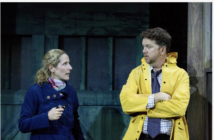
MA RAINEY’S BLACK BOTTOM
I’ve appreciated the works of playwright August Wilson since I saw his very first play in his famous “Pittsburgh Cycle” many years ago. (With Ma Rainey’s Black Bottom, I’ve now seen all ten of the plays under that umbrella.) However, because of the inherent sadness of the plight of the Americans depicted in them, (despite all the brilliant levity,) I’m not exactly a fan. But I knew that A Noise Within would do Ma Rainey’s Black Bottom up to that theatre’s usual high standards, so I wanted to give it a look.
And I discovered yet another excellent production from this company. By the thunderous standing ovation, I know that the entire Opening Night assemblage felt the same way. I’m glad that good theatre companies such as this one bring us August Wilson’s plays from time-to-time, to keep the history of the black struggles alive in our consciousness.
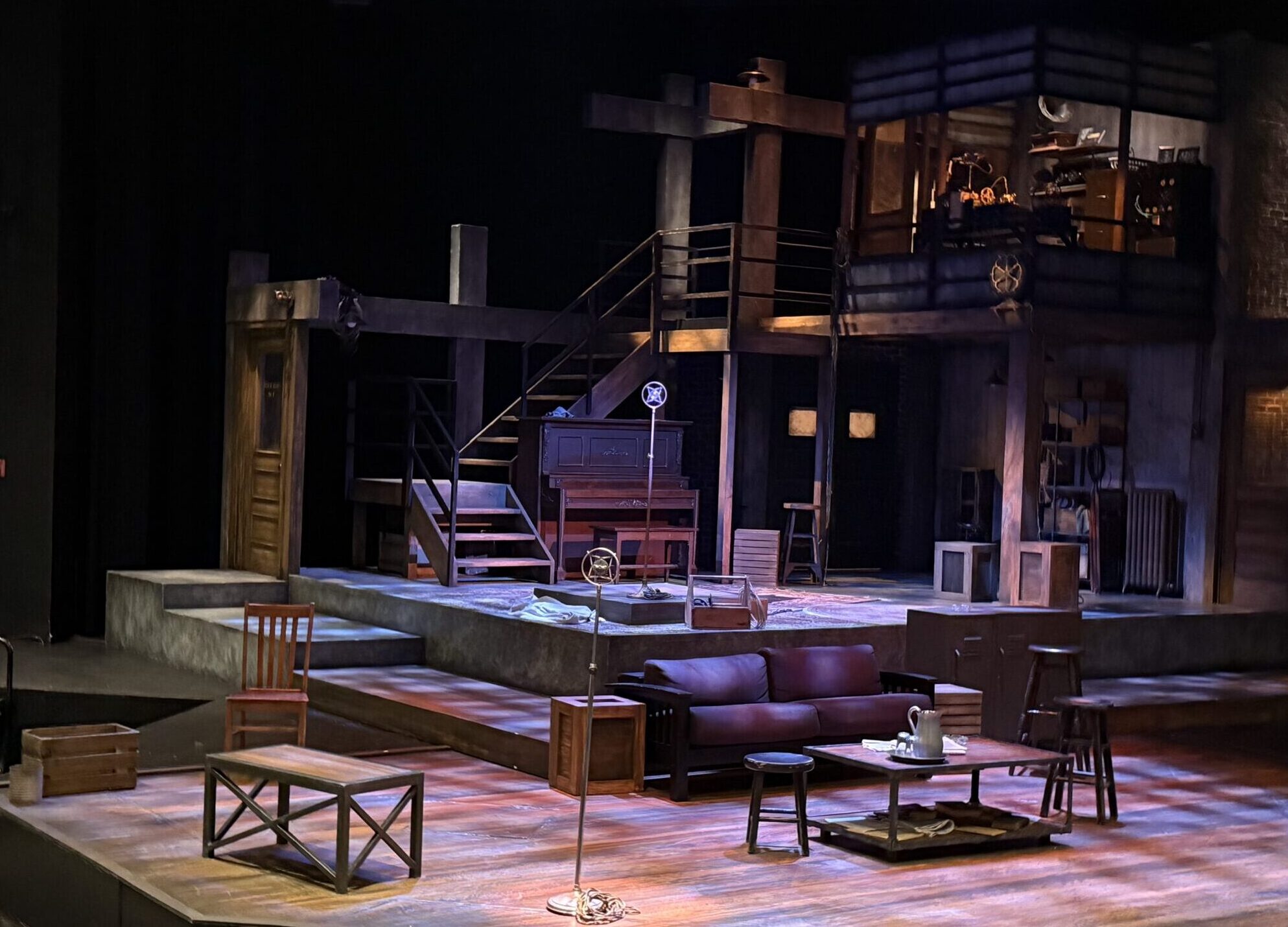
The set. Photo by Karen Salkin.
As I said, I had never seen this play, but, of course, I saw the 2020 film version. However, very surprisingly for my crazy-good memory, I do not remember it. (That lapse in memory might be because I had to close my eyes for a lot of the film, for them to not be assaulted by Viola Davis’ perennially-running nose!) So I thank A Noise Within for helping me complete Wilson’s ten-play cycle.
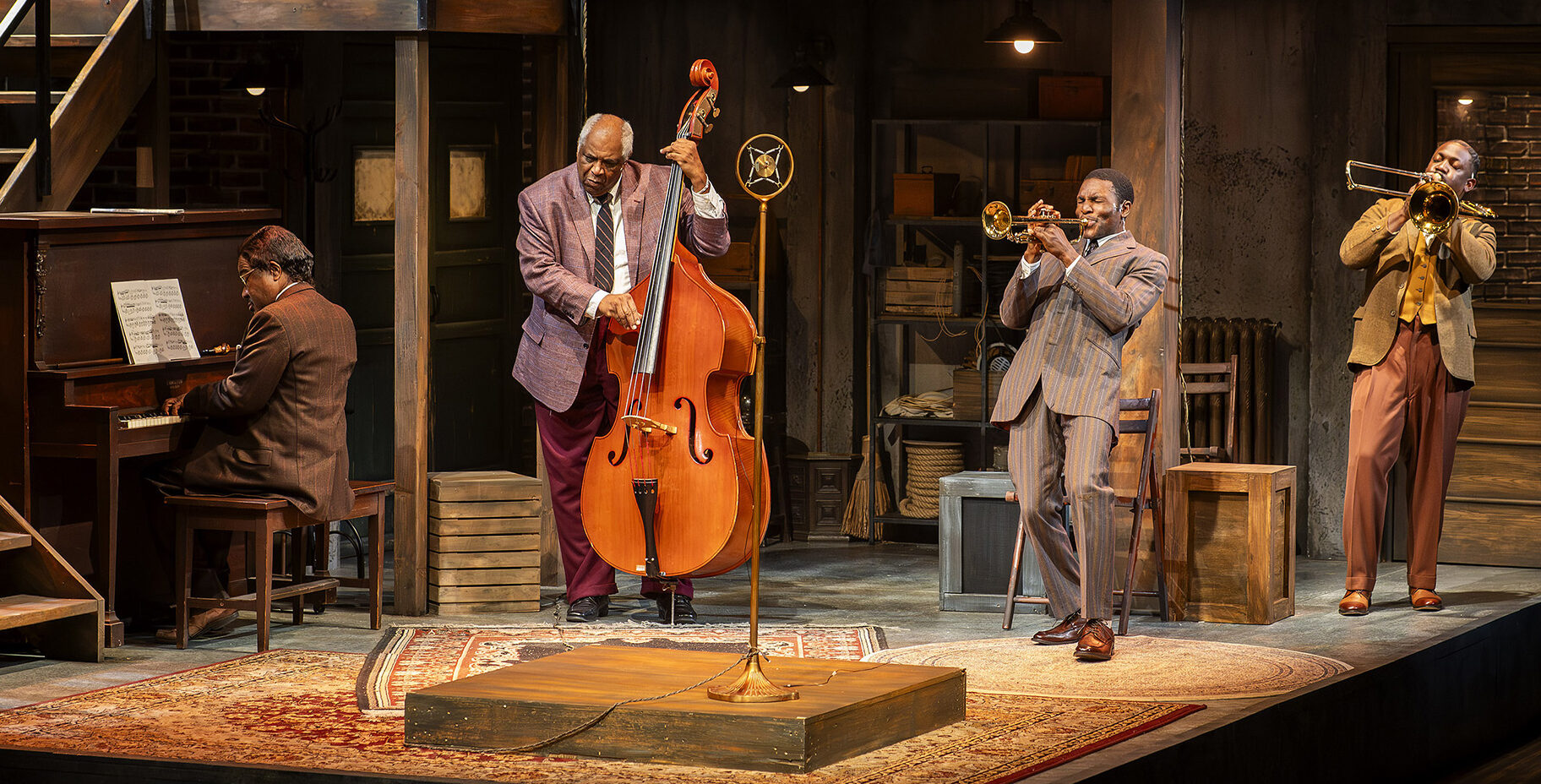
The setting is a 1927 recording session for blues singer Ma Rainey, in a studio depicted perfectly by Tesshi Nakagawa’s excellent multi-level set. But the story is of soooo much more than that! That’s all you need to know going in.
In case you’re curious, Ma Rainey was a real person, (known as the “Mother of the Blues,”) in the ’20s, and she did have recording sessions at this portrayed studio. But the events and other characters are fictitious. And because the location is true, this is Wilson’s only play that’s not set in Pittsburgh, but rather in Chicago.
Because it takes place during a recording session, with a real-life singer, many people erroneously think this is a musical. (One friend told me she can’t see this show because it has “loud music,” even though she had absolutely no idea about it, and was totally wrong!) But it’s actually a play with a tiny bit of music. I think there’s actually only one song from Ma in the whole show, and a little bit of playing from the musicians before she shows up. And that’s it. (And despite the actors’ near-perfect pantomiming of playing, they are not the ones doing it in reality. The timing of their “instrument-syncing” to pre-recorded music is so good that it fooled my friend! And I’m sure many others.)
Every single performer is on the highest level. The opening night audience went berserk for them all.
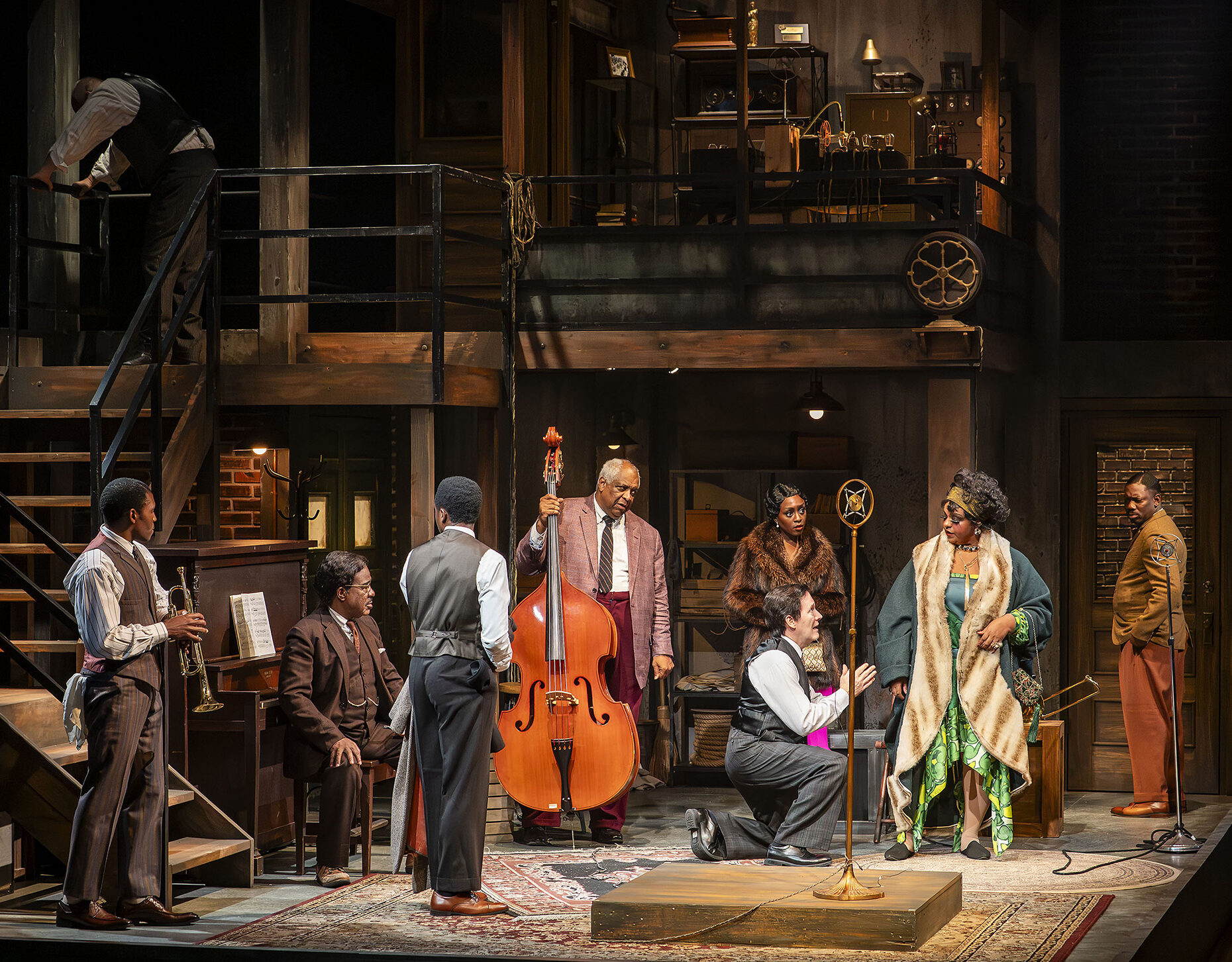
Matt Foyer (on stairs), and then (L-R) Jamar Gilbert, Gerald C. Rivers, Francis C. Edemobi, Alex Morris, CJ Obilom, Bert Emmett, Amber Liekhus, and Kai A. Ealy. Photo by Craig Schwartz, as is the one at the top of this review.
But carrying the heaviest load is Jamar Gilbert as Levee, the enterprising trumpet player whom the rest of the musicians constantly make fun of. On the way out of the theatre, a knowledgeable young guy told me that he enjoyed Jamar’s performance even better than that of Chadwick Boseman in the movie, and I readily agreed. (No disrespect to Chadwick at all. It’s just that the play is totally amusing while the movie is just depressing. That’s the difference in mediums—I first noticed that discrepancy many years ago when I saw a production of Who’s Afraid of Virginia Woolf, and could not believe how much humor there was! And, in this case, Jamar’s portrayal of Levee is both a riot and very depressing.)
All four of the actors playing the musicians, (in addition to Jamar, there’s Gerald C. Rivers as “Toledo,” Kai A. Ealy as “Cutler,” and Alex Morris “Slow Drag,”) are so authentic. If I was not already familiar with Rivers’ work, (I’m so sorry I missed him in Treasure Island this summer,) I would have thought they were real old school musicians joking around with each other, as opposed to actors speaking scripted dialogue!
(L-R) Gerald C. Rivers, Alex Morris,
Jamar Gilbert, and Kai A. Ealy. Photo by Craig Schwartz.
Same thing with Amber Liekhus as Ma Rainey, whose little bit of singing brought the house down. She’s perfect for the title role.
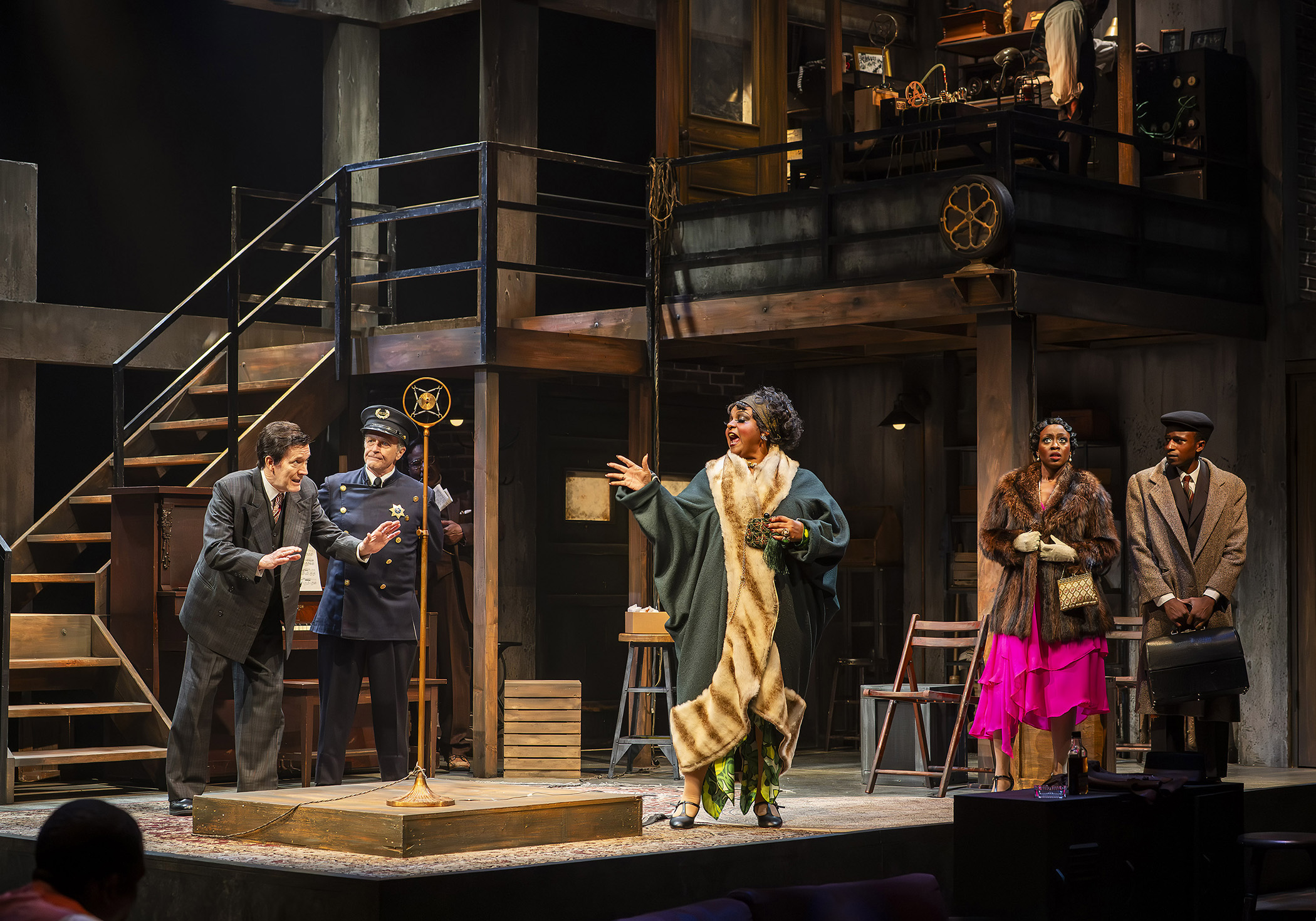
Actually, every cast member is at the top level, so I feel the need to laud the rest of the company, as well. Bert Emmett is especially funny as Ma Rainey’s manager Irvin; Francis C. Edemobi does a great job of stuttering realistically as Ma Rainey’s nephew Sylvester; Matt Foyer is spot-on as the let’s-get-it-done-already owner of the studio; CJ Obilom is eye candy for the boys (and girls) as Ma Rainey’s love interest Dussie Mae; and James Nardini is an appropriately racist policeman.
The scenario is all very amusing, (until it turns serious,) but I couldn’t make-out all the repartee because of the dialect, which happens all the time in plays. (I’ve gotten way too used to having the luxury of closed captioning on TV!)
There is one questionable little part about this presentation, which I believe is not in the original. At the very beginning, a trio of the characters, (not Ma Rainey,) walk down the aisle to the front of the stage, and stand in front of an old-fashioned microphone. The girl attempts to sing, but then looks like she’s seen the devil or is possessed or something confusing like that. It turns-out that it has nothing to do with the story, but, since I didn’t know that, I was distracted by that bit the entire time, trying to figure out what it means. But it has nothing to do with the script, so it’s just a tad of annoyance for no reason that I can see. (If you see the show, which I suggest you do, and understand that prelude, please let me know in the Comments section below.)
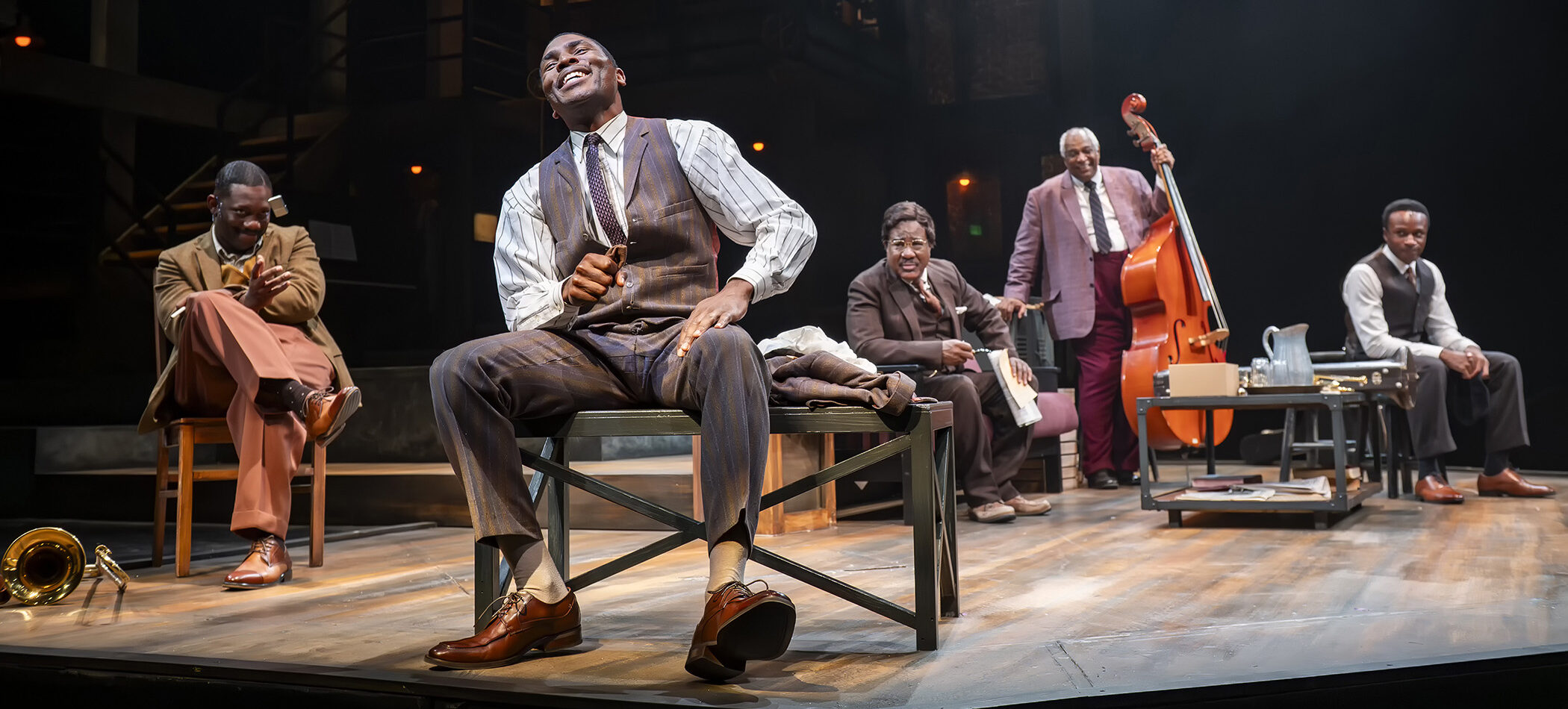
(L-R) Kai A. Ealy, Jamar Gilbert, Gerald C. Rivers, Alex Morris, and Francis C. Edemobi.
Photo by Craig Schwartz.
On the flip side, there are so many clever lines and bits that the audience I saw it with especially enjoyed. At one point, one of the musicians tells Levee, “You ignorant without a premise!” I can’t wait to use that line myself! Later on, Toledo says, “Some mens are excited to be fools.” I hear ya on that one! And all of our fave was that every time Cutler was counting the rest of the guys down to begin playing, he did it by saying, “One, two, you know what to do.” After the third time, we all said it with him! I have never heard an audience do that in the middle of a play! Fun.
There is one bit in Act II where Ma demands “my Coke,” which brought to mind a famous part of another of Wilson’s plays, Two Trains Running. In that one, (which he wrote four after Ma Rainey’s Black Bottom,) the character Hambone declares over and over, “I want my ham!,” from a shop owner for whom he did some work in exchange for said ham. Although he never gets his ham that he begs for the entire time, Ma Rainey does get her Coke after several attempts. (I wonder if Wilson even thought of that comparison while he was writing the latter play!)
Okay, I left the reason for my non-fanship of August Wilson’s plays for last. And that is that I cannot stand to see misery. Even though his works are fictional, you know that people have always have gone through real-life situations that are very close to his fictional ones.
As a person who planned to name my company “Happy Endings,” that’s really the only thing I like to see. Perhaps that’s why I blocked-out the Ma Rainey’s Black Bottom movie, (even more than the aforementioned runny nose.) I hate people ganging-up on someone and ridiculing them, even in fun; in this case, that’s what the rest of the musicians do to Levee. As amusing as much of the banter is, it wore on my soul.
I also hate seeing people make fun of stuttering. As a former teacher, (and, actually, just as a human being,) I’ve seen too much of that meanness in my life. So I do not love this script. But my friend Celia does.
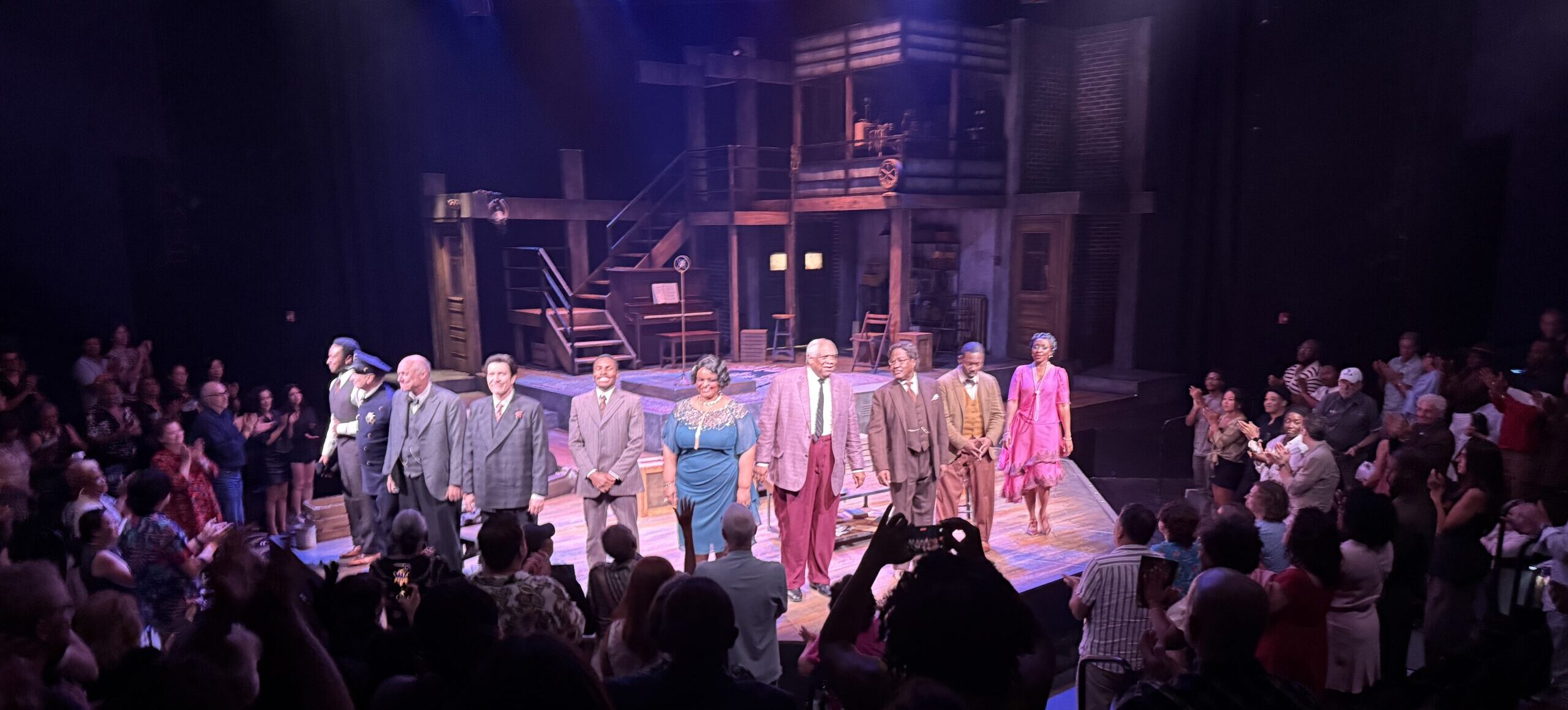
The Opening Night curtain call. Photo by Karen Salkin.
So let me end on that high note. And this one: This was Celia’s first time at A Noise Within, and she was impressed. She said it lived up to my glowing reviews of the experience—beautiful theatre, very comfortable seats, perfect sightlines, plenty of space, easy free parking, and fun Opening Night Party. So we both recommend that all of you go have this wonderful experience, (sans the fete,) for yourselves. Just be aware that August Wilson plays rarely end happily.
Ma Rainey’s Black Bottom running through September 20, 2026
A Noise Within 3352 E. Foothill Blvd. Pasadena
626-356-3121 www.anoisewithin.org