ENGLISH AT THE WALLIS
Many years ago, I was a big fan of the very outgoing French Olympics-medalist figure skater, Philippe Candeloro. So when I met him through a mutual friend, and we club-hopped all night, I was surprised that he was so quiet. And then, at 2AM, he asked if we could stop into a French restaurant to see the owner and staff he knew, and after he talked with them in their mother tongue for about only twenty minutes, he was a new man! He became the bubbly personality I had always seen on TV.
That one night taught me a major lesson about language and what it means to everyone in the world to be able to claim their identity by speaking their native one. I reflect on that experience quite often, actually.
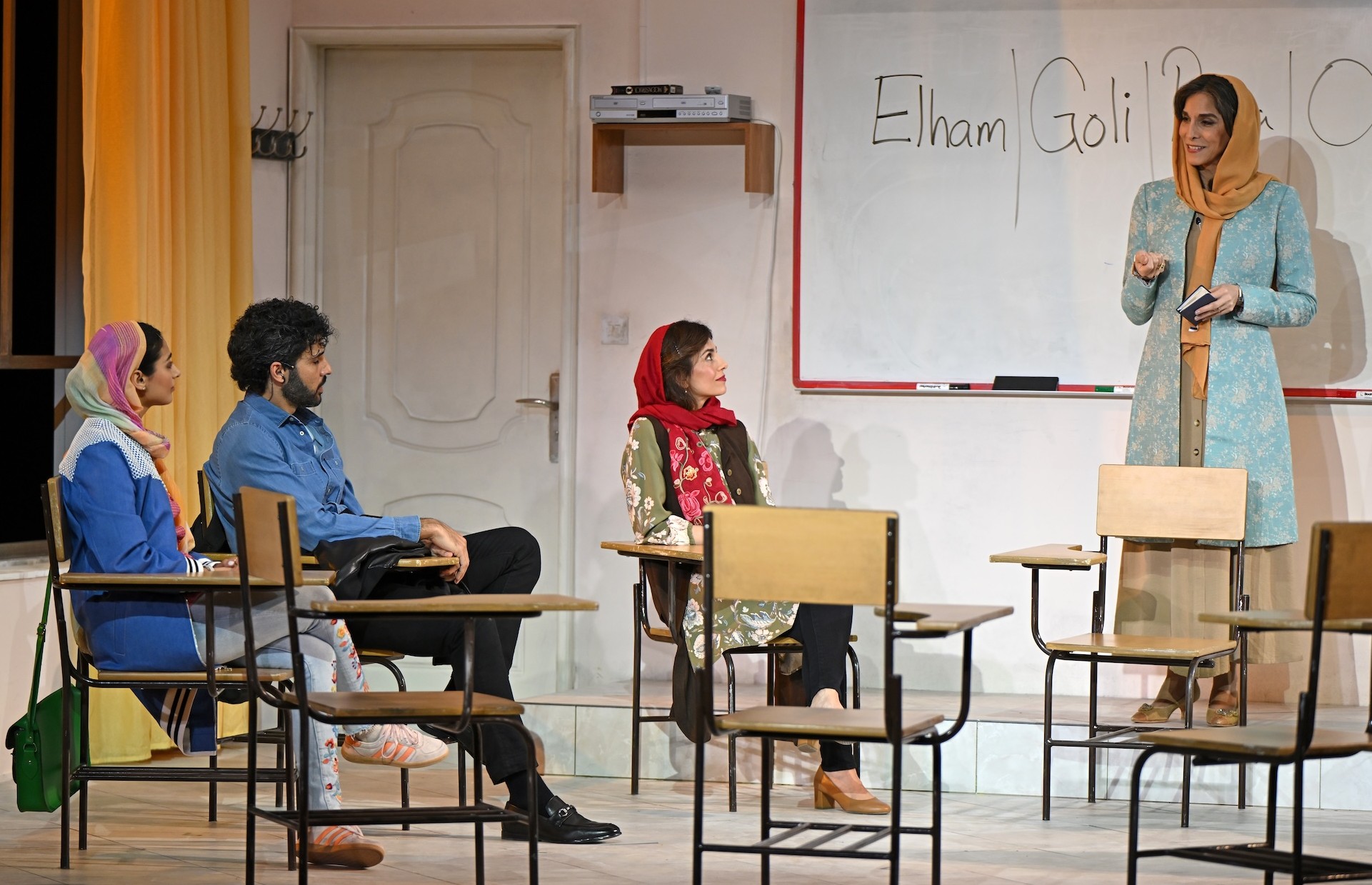
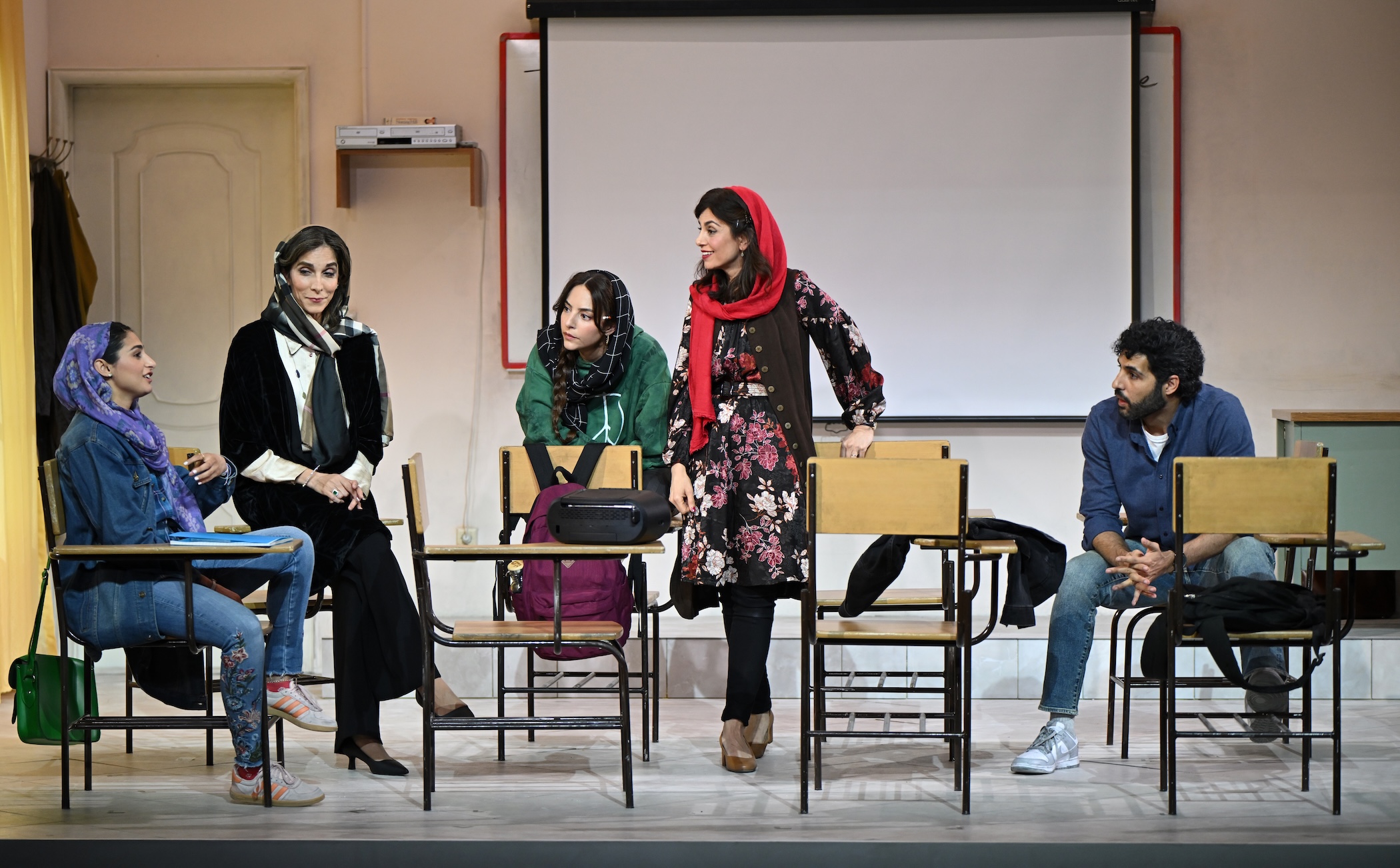
(L-R) Ava Lalezarzadeh, Babak Tafti, Marjan Neshat, and Pooya Mohseni. Photo by Kevin Parry, as is the one above.
So I was happy to discover that the Pulitzer Prize-winning and Tony-nominated play, English, now playing at the Wallis, is sharing that same sentiment in this high-quality show direct from Broadway. It stars four-fifths of that original cast—Ava Lalezaradeh, Pooya Mohseni, and Tony-nominated actresses Tala Ashe and Marjan Nashat—along with new guy Babak Tafti.
To be completely honest, despite me having been a teacher, and my parents being English and Speech teachers, (so language has always been a big part of my being,) I was hesitant to see anything that might be serious these days. As most people I know are, I’m upset enough by what is happening in Iran right now, in real life, that I didn’t know if my mind could handle a fictional tale set in that country. However, because English is playing at the Wallis, my favorite theatre, (which has never disappointed me,) I knew that I shouldn’t miss it. And neither should you. (And I was glad to see a longer-running show from them, which they used to do quite often, as opposed to their recent mainly one-to-three night events.)
On the surface, English is a character study of the lives of five semi-strangers, with lots of humor. Digging deeper, it’s really a very thought-provoking piece on how language affects people’s lives, which is a universal experience. And it’s perhaps more relevant now than when it began in New York a few years ago due to the lunatic in the White House who is threatening Iran that their “whole civilization will die!”
As hard as this will be for me to do, I’m going to try to review the excellent play and performances I witnessed on Opening Night of English, and leave politics out of it. After I cool down for a moment. (And, in a separate column this Friday, I will be featuring some personal reflections that the scenario brought up for me, including a more in-depth look at that first night with Philippe that I referenced at the top of this review, and my own experience in a “Spanish only” class. Not fun. For anyone! You’ve never heard Spanish, French, and Latin till you hear them spoken with a Brooklyn accent! Shockingly, a play that takes place in Iran reminded me of more events in my own little very American life than any other entertainment ever has!)
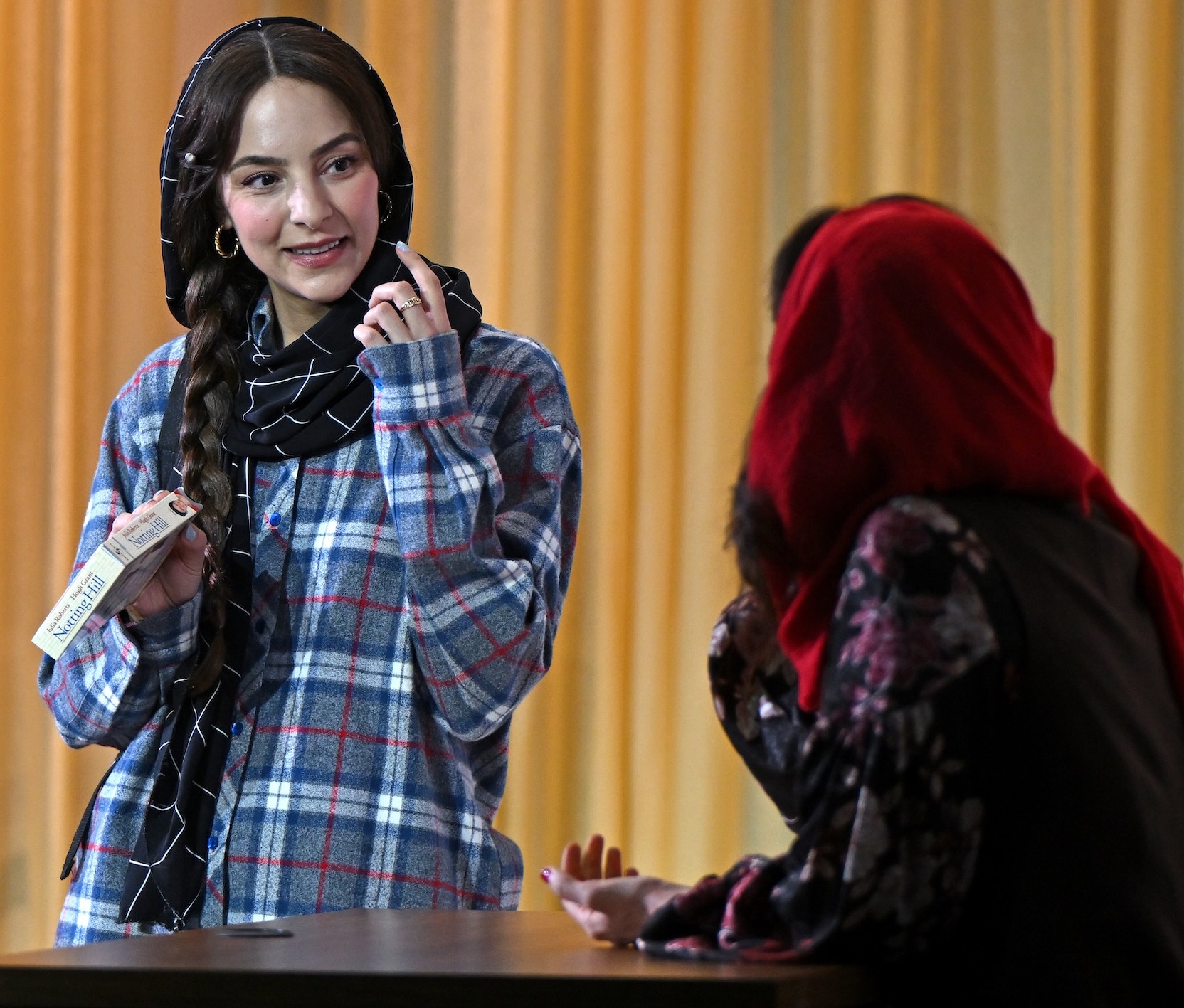
Tala Ashe and Marjan Neshat. Photo by Kevin Parry.
The hour-and-forty-four minute (with no intermission) play is set in a classroom in Iran in 2008, and features the teacher and four disparate adult students who are studying for a Test of English as a Foreign Language (TOEFL.) Each character’s reason for being there is different and equally interesting, as are the actors who play them. My favorite, (and perhaps everyone’s because she’s the funniest,) is Tala as Elham, the girl who hopes to move to Australia and become a doctor. The character would be my bestie in real life.
I’ve known Iranian people since I was a teenager, and never thought that their accents made them lesser. Actually, it was quite the opposite—I thought the first guy I knew at URI was a Prince because of the lovely way he spoke! So it’s hard for me to really feel what these people in the play would be going through almost twenty years ago. But the script and actors sell the situations.
The playwright, Sanaz Toossi, implements a very clever device to help the audience along the way. During class, the students are supposed to speak English only, (it’s even declared in big letters on the whiteboard at the front of the classroom, so that the audience knows it, as well,) but as in all foreign language classes everywhere, the learners can’t help but to revert back to their own tongue every now and then. So, to let us non-Farsi speakers in on the distinction, when the characters speak English, they have thick Iranian accents, and when they are speaking Farsi, they actors speak in unaccented English. It took me a second to realize what was happening—I thought that Ava, the young actress, had just gotten nervous because it was the opening, and forgot to use her accent for the play! But after that first minute, it worked beautifully.
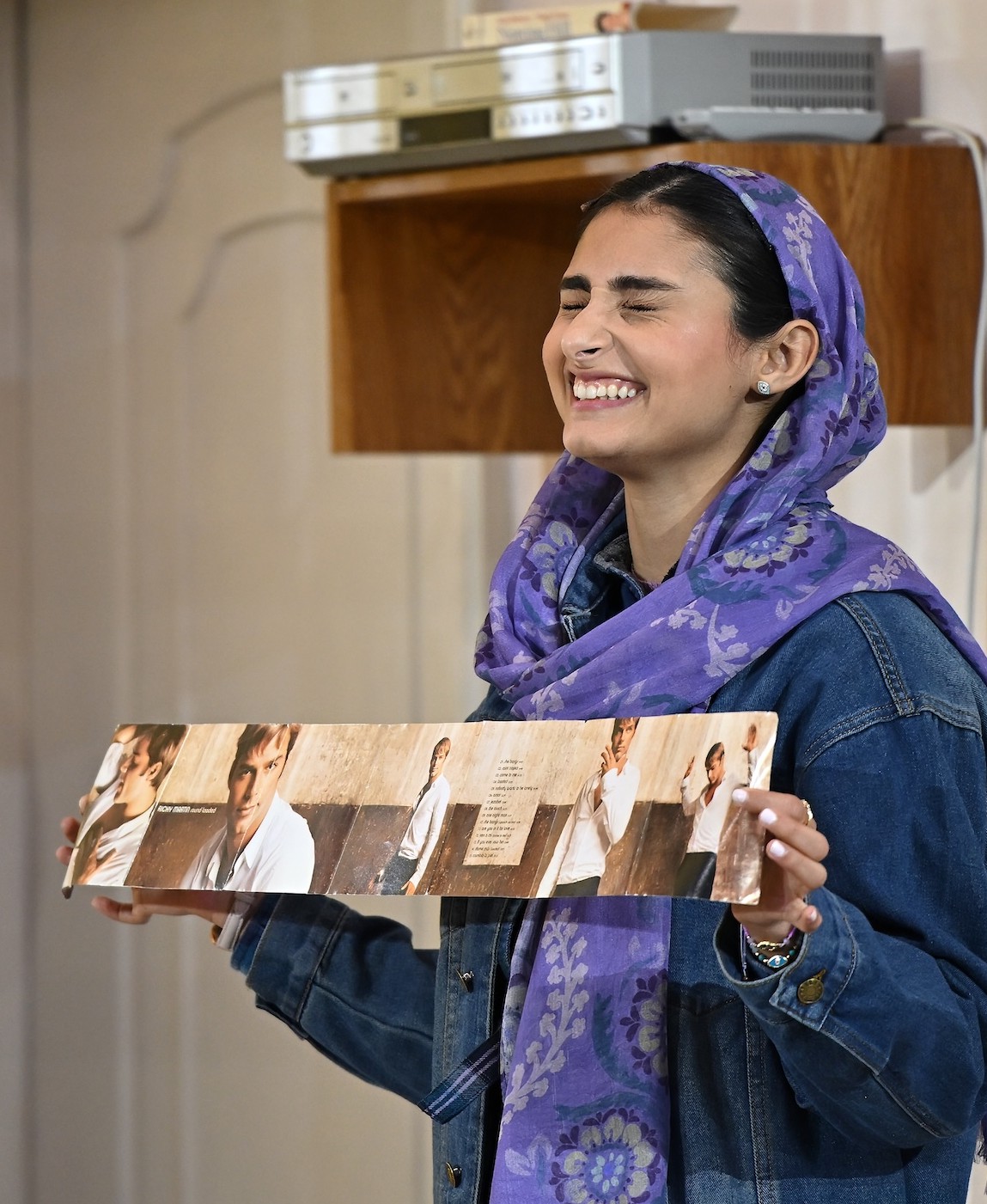
Ava Lalezarzadeh, using Ricky Martin for Show & Tell. Photo by Kevin Parry.
As good as the presentation is, I have to admit that there are three issues I did not understand. Firstly, I don’t get why at least two of the students indicate that they need to pass that test. If reasons were given along the way, I missed them. I believe that in the U.S., English as a Second Language, (ESL,) classes are just for the students’ own reasons, and are not required for anything official. (I’ve been asked to teach those classes myself, but I’ve always been afraid that I talk too fast for anyone to follow. Even native English speakers have trouble with my speed on occasion.)
The second one, (which my friend Marc absolutely cannot let go,) is that one of the students doesn’t show up again about halfway through, and none of us know why. We were really hoping that it would be explained by the end, but it does not. And I hate having it left up to our own interpretations, especially since Marc calls me with a new theory every few hours!
Lastly, in the final scene, Elham is in the classroom alone, drawing on the board, when Marjan, the teacher, comes in, and tells Elham that her classroom is across the hall, and says her own new one is comprised of young students. And then Elham admits she did pass the test, with flying colors, so why is she still there, when her plan was to go to Australia to study medicine? And even if she decided to stay put in Iran, what is she still doing in the school and why a new class? We thought that perhaps she was teaching it, but wouldn’t Marjan have known that she was doing so? I’m so confused.
But none of that takes away from the excellence of the play, which is interesting throughout. Even though English does get a tad lengthy for just one act, I never checked the time. So I suggest you just go with the flow and enjoy it.
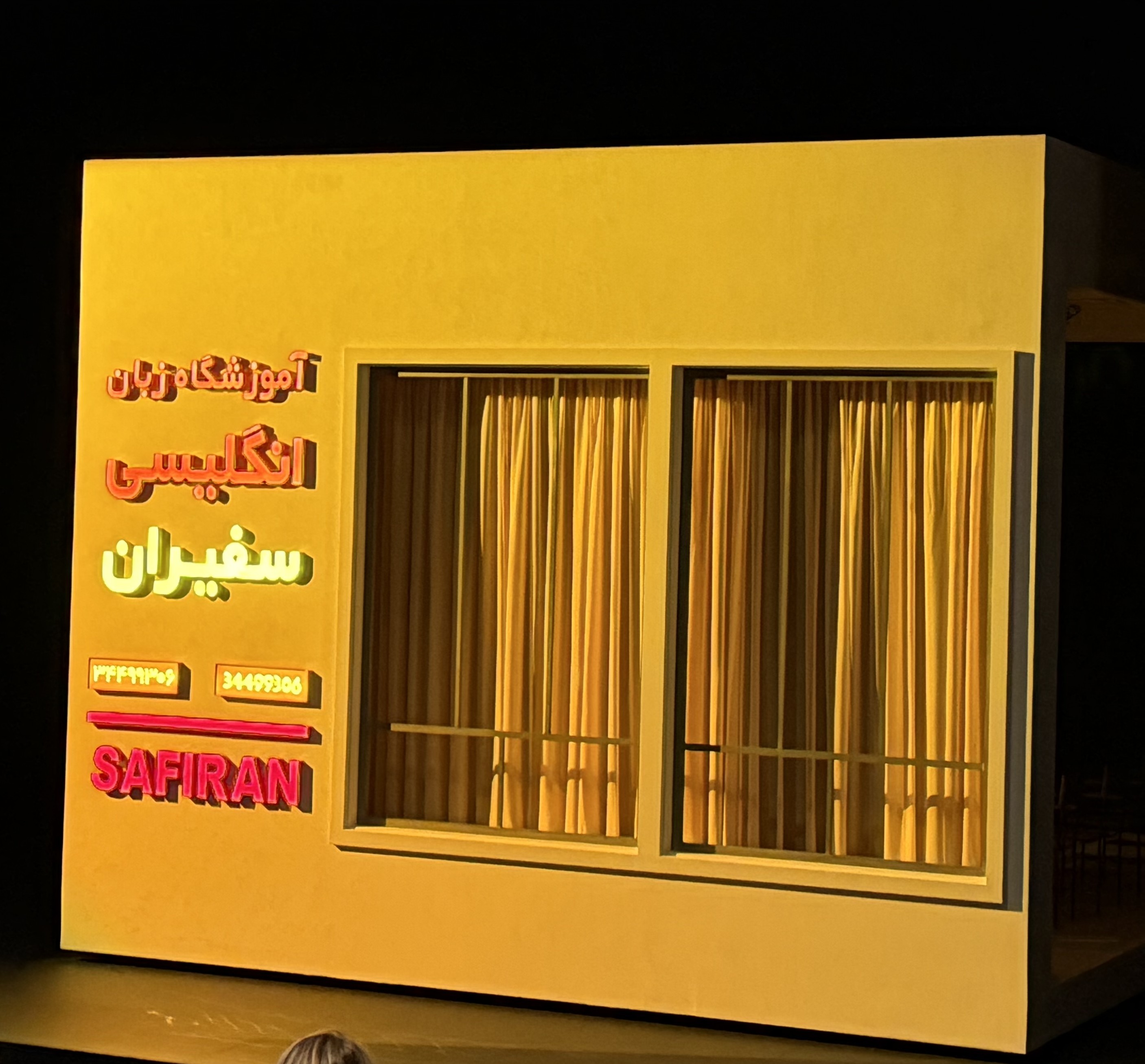
This is the front of the cube that’s in the middle of the dark stage before the show begins. Then it turns to reveal the classroom. Photo by Karen Salkin.
Marsha Ginsberg’s set is basically a giant cube in the middle of the stage; it’s just one classroom, with the outside visible in a couple of scenes in front of it. To make it more interesting, the whole thing moves a bit from scene to scene, so every section of the audience gets a different angle each time. I liked that usage, except for one giant column on one of the corners which obstructs some audience members’ views of the actor speaking on occasion. If that post is necessary to hold up the set, okay, but otherwise I think that future productions should lose it.
However, also on the technical side, the interstitial music is perfect. It really adds to it, as does the sporadic background music.
And I love that Ricky Martin’s song, She Bangs, even makes an appearance! So does a bit of the popular film Notting Hill. You’ll just have to see for yourselves how it all fits into English, which I strongly suggest that you do in these last two weeks of its limited run at the Wallis. I hope it gives all of us a better understanding of the power of language. (And please look at the back of the promo flyer on offer at the theatre—one side is written all in Farsi, which boggled my mind when I noticed how gorgeous that writing is!)
English running through April 26, 2026
Wallis Annenberg Theater For The Performing Arts
9390 N. Santa Monica Boulevard Beverly Hills
310-746-4000 www.thewallis.org