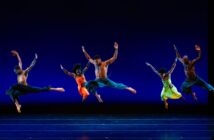
DANCING WITH BOB: RAUSCHENBERG, BROWN & CUNNINGHAM ONSTAGE
As much as I love variety in venues, I wish that every show in Los Angeles would be at The Wallis! I adore that theatre so much. My friend Gigi and I went there last week for this iconic dance performance, and we both admired how perfect the seats are. Gigi hadn’t been to the Wallis since it first opened, and she was uber-impressed that it was sold-out…for dance! Not every venue can claim that accomplishment.
At just seventy-five minutes, Dancing With Bob, (referring to the late artist Robert Rauschenberg, to whose centennial this was all a tribute,) is very short. It consists of two old school pieces by the Trisha Brown Dance Company. Gigi and I didn’t understand one minute of either of the numbers; however, I always appreciate these opportunities to see shows like this one that I feel are an important part of a complete dance education. And any entertainment that inspires me to go home and do deep research is fine with me.
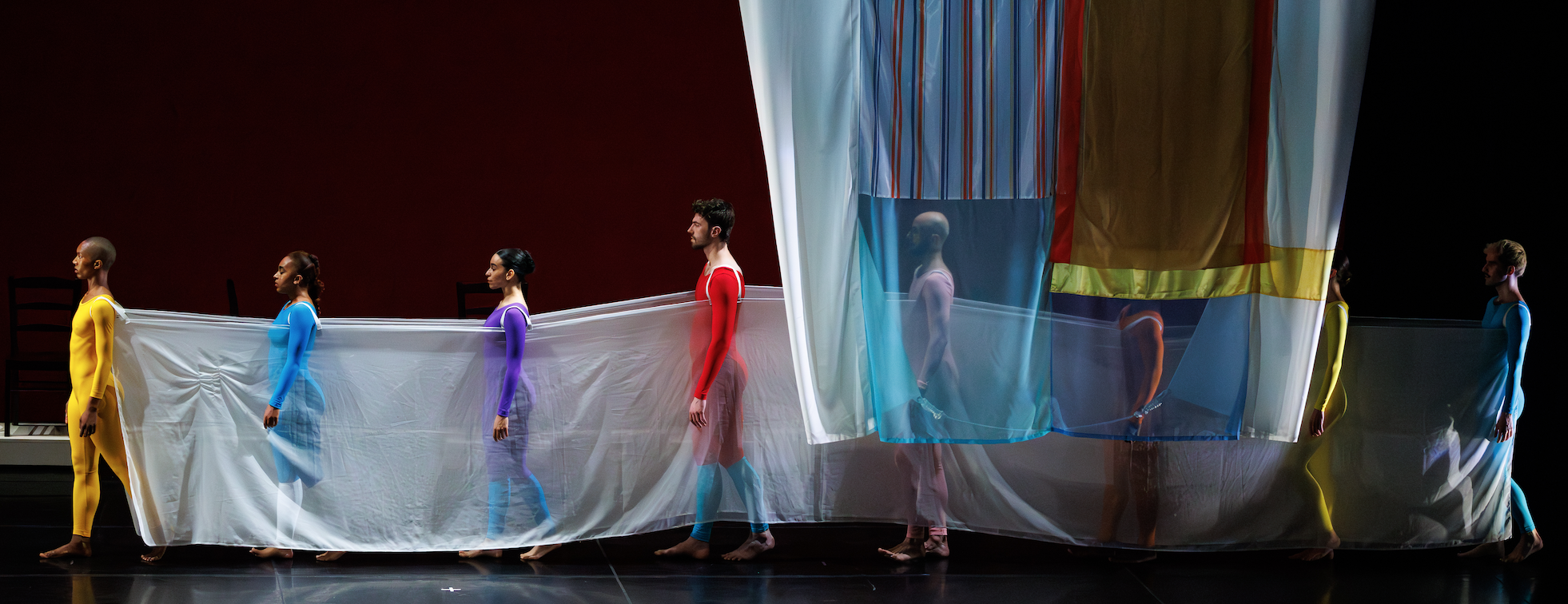
Travelogue. Photo by Ben
McKeown, courtesy of the
American Dance Festival, as is the one at the top of this review.
The choreography for both consisted of the old-fashioned Martha Graham type of Modern Dance, as opposed to the Contemporary style to which we’ve all become accustomed. The entire presentation was very different from the kind of dance that we see most often these days. It was like a time warp! And we Angelenos were very lucky to travel back in time to see how things were done back then. (On an interesting side note, Martha was actually the person who discovered young Merce Cunningham, whose choreography and legacy are a main component of Dancing With Bob.)
I have to admit that as girls who have both trained in, and love, ballet and hip-hop, along with Afro-jazz for me, and Bollywood for Gigi, Dancing With Bob turned-out to be not exactly our cups of tea. However, a wise young friend, (really young—Lula was only nine-years-old at the time,) once told me that it’s not a matter of whether we like something we’re seeing or doing; it’s more about if it’s our style. Keeping that declaration in mind, it’s not that Gigi and I didn’t like this show; it’s just that it was not our style.
But I so very much appreciate that we got to witness dance history in person like that! The late Merce Cunningham was the recipient of every honor in the book, so who are any of the rest of us to judge any of his many accomplishments? It’s one of the few times I can actually say that I’m not worthy.
The first routine of Dancing With Bob was the late Trisha Brown’s Set and Reset, from 1983, with music composed specifically for it by avant-garde electronic artist Laurie Anderson. (It featured non-stop ringing bells, so think if I liked it. I’ll leave it at that, even though I really want to say that my ears were ringing as much as the music! But I won’t.)
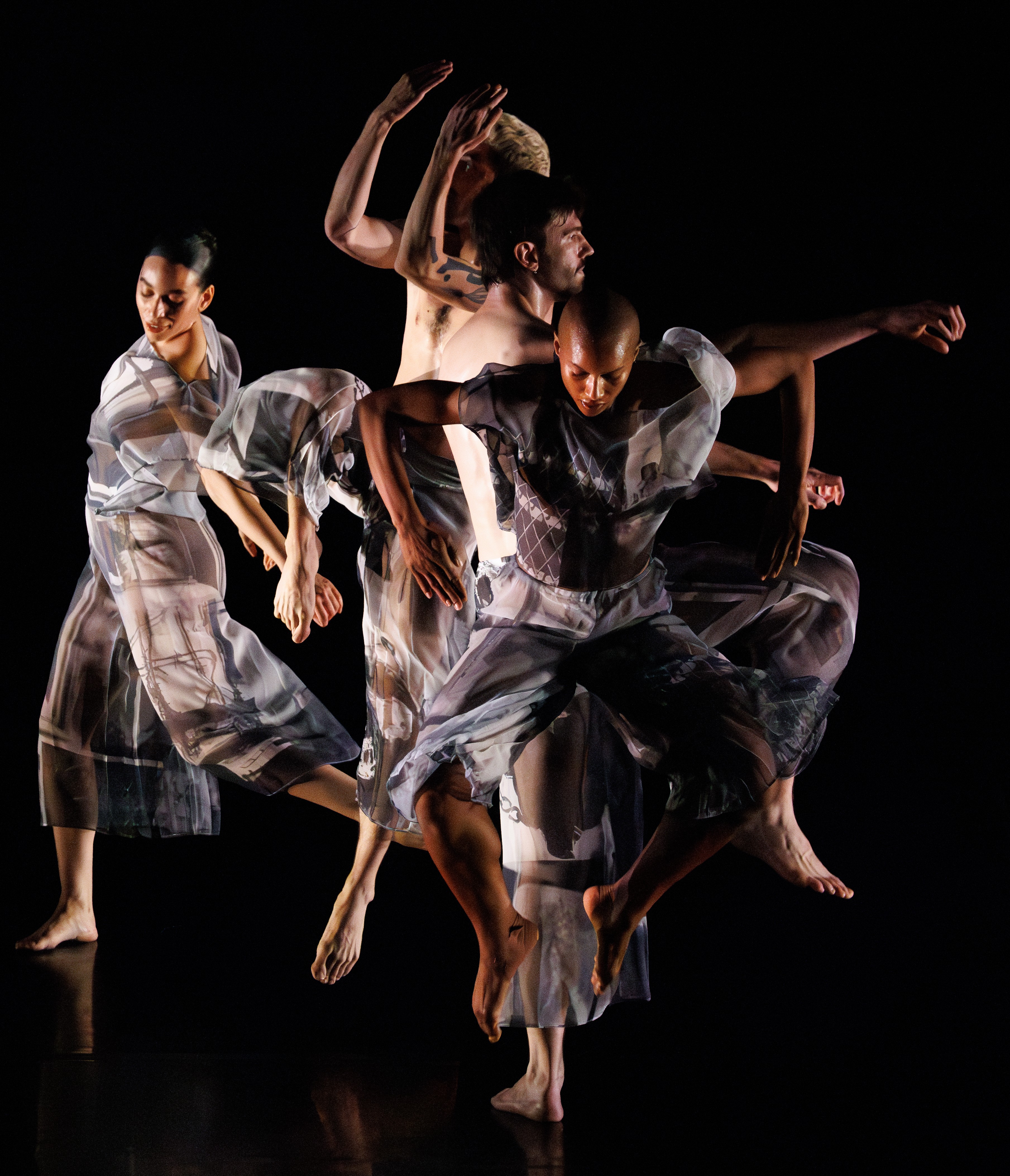
Set and Reset. Photo by Ben McKeown, courtesy of the American Dance Festival.
I usually hate dark stage lighting, but in this case, it was fine because, somehow, it made the shapes the dancers were creating a bit easier to see. Their constant movements were very fluid and beautiful.
The number featured black-and-white overhead projections, but I never looked at them; I just wanted to concentrate on the dancing. So I don’t have a clue what was going on in them. Because of the screen’s positioning—at the top front center of the stage—I was thinking that perhaps it was acting as a third eye because who knows what people were thinking of back then. I wish I had glanced at the screen a bit now.
Even though also featuring long-ago choreography, (by Merce Cunningham this time,) the second half number, 1977’s Travelogue, was actually very different from the first. It featured costumes and a set, (or semblance thereof,) by that night’s tributee, prolific artist Robert Rauschenberg, whom I later discovered also occasionally choreographed. It’s not fair for someone to have two major talents like that! (Hey buddy—leave some for the rest of us!)
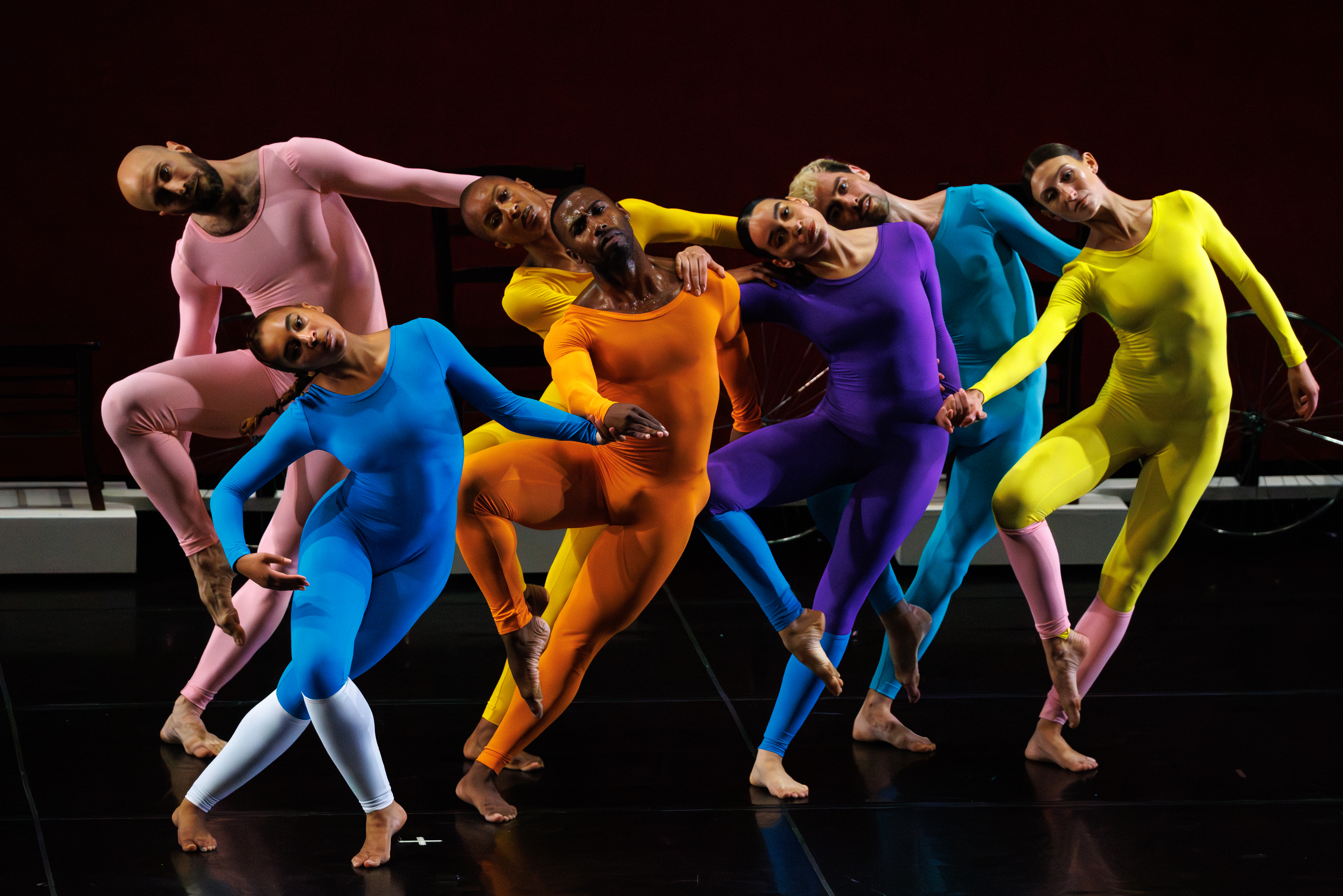
The costumes, which were leotards and matching tights, were each one beautiful bold color. They reminded me of a giant crayon box, so that made me very happy. (I have a room in my house called the Crayon Room. No lie.) Those colors in the promos are the reason I wanted to see Dancing with Bob in the first place!
The opening tableau, which moved slowly onto the stage, was striking. But the seated positions of the dancers in it made me think that they were about to do Fosse-esque movements, which they did not, (because that would be another show entirely,) so I was a little disappointed there.
I read later that Travelogue was meant to be amusing, but GiGi and I didn’t get that at all. When it was over, she kept asking what it all meant, declaring, “It made no sense!” But I’m guessing making sense was not a concern of choreographers back then. Making art was. (And still is.) However, some members of the audience we saw it with did chuckle from time to time, so at least a few other people found a bit of mirth to it.
But it reminded me of a dance (or acting or improv) class before it begins, when everyone is just doing movements they think will warm them up or maybe secretly impress the other students. Visions of leg warmers were dancing in my head. Perhaps the number was parodying all that.
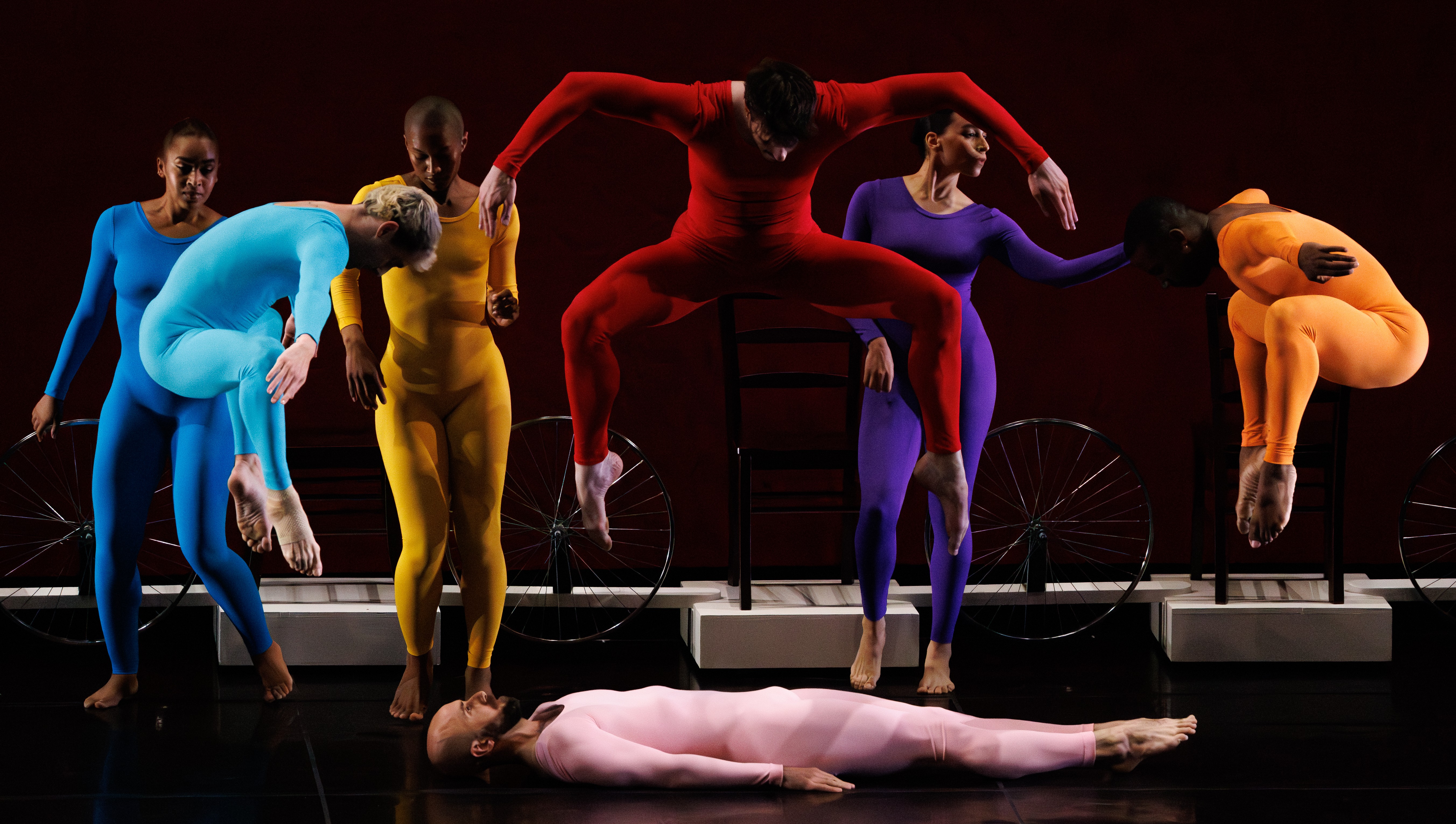
Travelogue. Photo by Ben
McKeown, courtesy of the
American Dance Festival, as is the one at the top of this review.
One major aspect of that presentation really confused us. Before Travelogue began, I noticed three people dressed in black seated below and in front of the stage, sort-of in an elevated pit area, facing the audience. I thought that perhaps they were the musicians, but I felt they were not, maybe because of their facial expressions. As the number went along, they played and broadcast messages on their cell phones; it was weird, both because those really didn’t seem to go along with the dance moves, but mostly because…there were no cell phones, nor many recorded messages from businesses, in 1977!!! Perhaps when it was danced back then, they used brief recordings from radio and television shows. I admit I’m not an expert on that period of time—the ‘70s feel like the Dark Ages now. But I do know there were no, or very few, cell phones. So, since what we saw was the original choreography, I feel the words of whatever the piece was trying to convey should be the original, as well. (Or maybe they could have just gotten rude audience members who are on their phones to amplify their “very important” mid-performance phone convos. The only problem with that concept is that the Wallis always has the most well-behaved audiences—except for the woman two rows in front of me who had her hair sticking straight up a high messy updo—which means that no one would be on their phones there!)
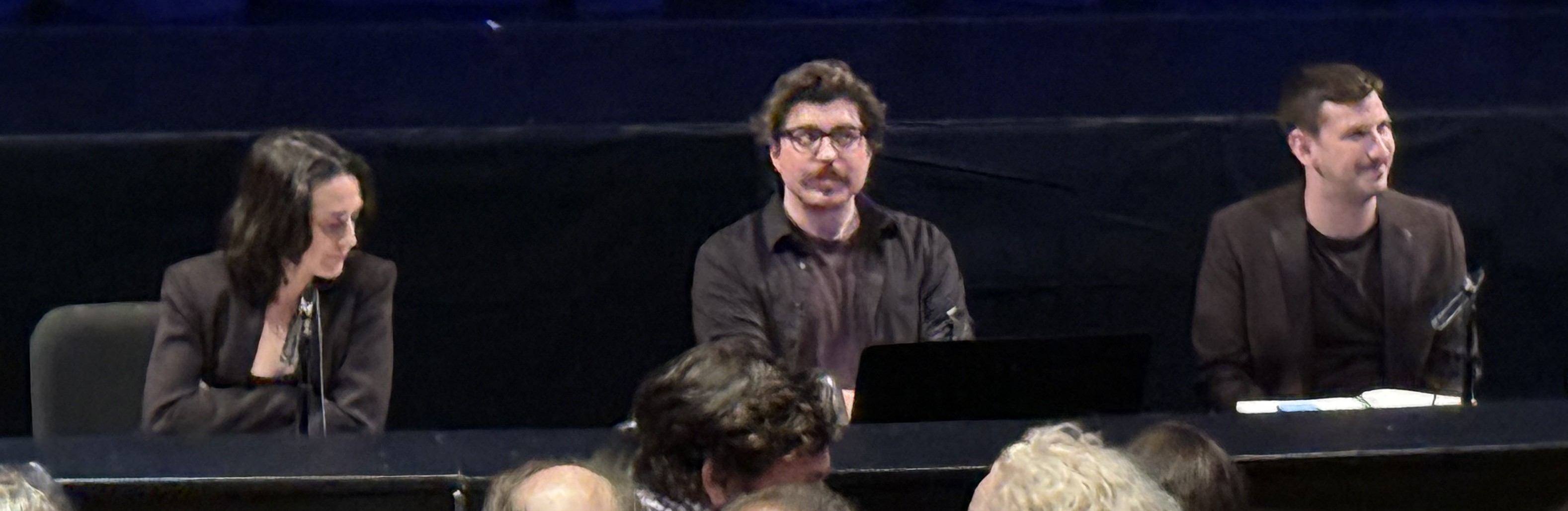
The trio who played the phone messages throughout Travelogue. Photo by Karen Salkin.
Lastly, you know that I love when something inspires me to hark back to a happy pivotal moment in my own life, and this show did just that for me. So I’ll end the review with this tale. When I was a teenage dancer, both my college dance professor and the teachers in the Manhattan studio where I was also studying, recommended me to the Merce Cunningham Company, and I was offered an audition for a scholarship for their summer work-study program. I was grateful to receive that amazing opportunity, and actually considered it, but since I really did not love doing modern dance, I turned it down, and instead drove cross-country with a friend to check-out California as my summer adventure. And I wound-up adoring Los Angeles, of course, and chose to stay here. And the rest is history!
So whenever I hear or read Merce’s name, it reminds me that I made a perfect decision at a time in my life when I was never good at choices. I hope that a tiny part of any presentation at the Wallis can do the same for you.
For the rest of The Wallis’ upcoming schedule, including the last-ever LA performance of BodyTraffic in June, click here: thewallis.org.