THE CASE-BOOK OF C. AUGUSTE DUPIN
This is a different sort-of presentation for Beverly Hills’ Theatre 40. Rather than being an actual play, it’s a trio of Edgar Allen Poe stories strung together.
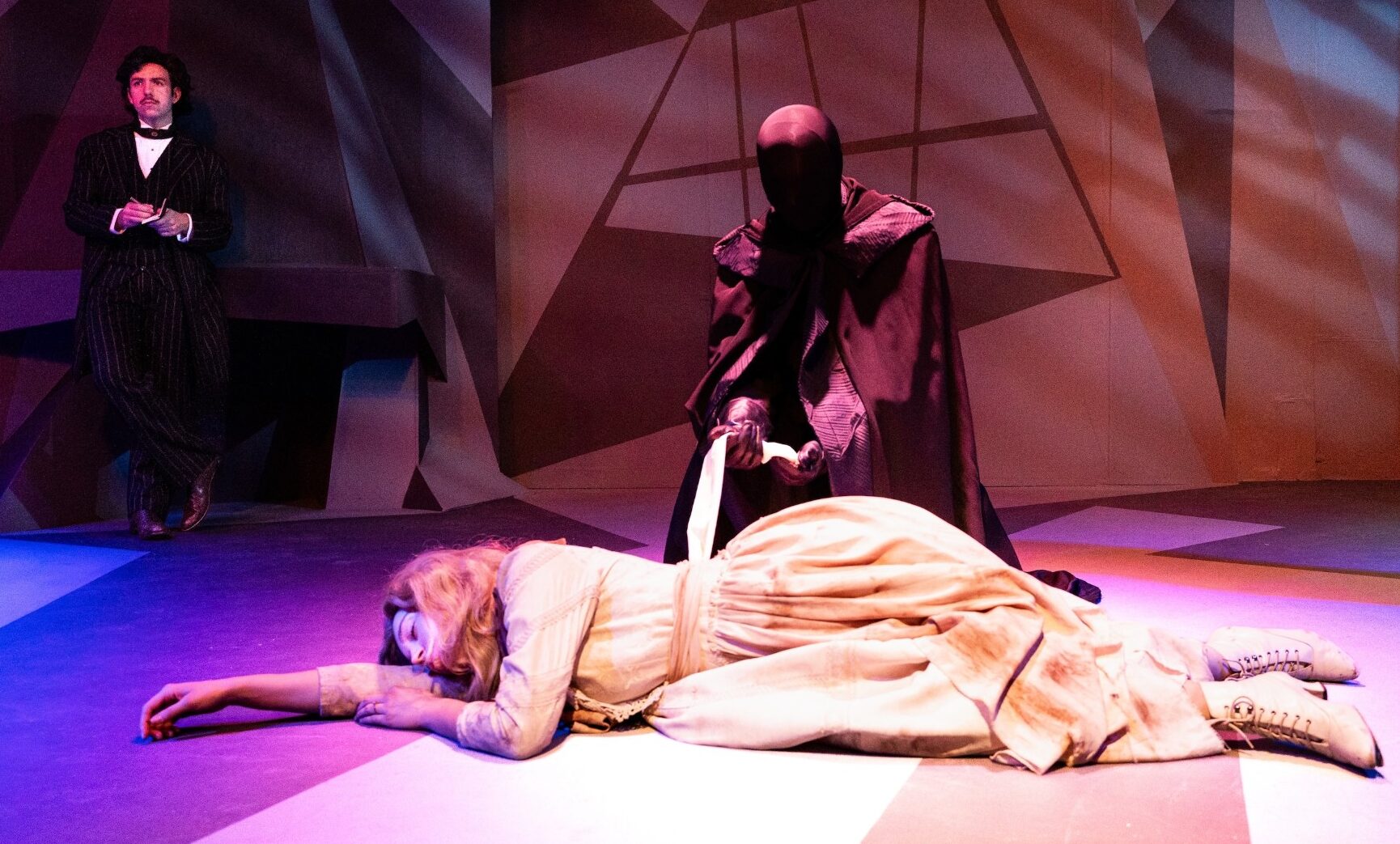
Patrick Grant, Isabella DiBernadino, and Danny Minshall. Photo by Eric Keitel, as is the one above.
Was it successful as such? That answer is also “sort-of.” I’ll explain in a minute.
But first, the main positives. This was my friend Gigi’s first visit to Theatre 40, and she enjoyed the experience as much as I always do. She said that my glowing description of the theatre is spot-on—the ease of location, the free parking right outside the door, and the comfort of the theatre itself. She told me that she “loved the ambiance of the theater as an intimate setting,” and she can’t wait to go back!
Secondly, I always appreciate an entertainment that inspires me to do some research on it, and that’s just what I did. I was amazed at how prolific Edgar Allen Poe was! I had been familiar with only two poems of his, and could have answered Jeopardy questions about “the writer of” a couple of his tales. And that’s it. So reading about his many accomplishments once I got home boggled my mind.
Now let’s get to this production of The Case-Book of C. Auguste Dupin. It’s something you have not seen anywhere else because it’s Poe’s three tales featuring detective C. Auguste Dupin melded into the one show. The first half consists of the famous The Murders in the Rue Morgue along with The Mystery of Marie Rogêt, and The Purloined Letter is by itself in the second.
The main problem with this Theatre 40 offering is that the whole thing is presented as more of a post-solve lecture with re-enactments, rather than an actual play. (I learned in High School Acting 101 to not do that—after getting the highest mark for my first assignment, a friend and I failed the next one because we tried to make a play scene out of one we saw in a movie.)
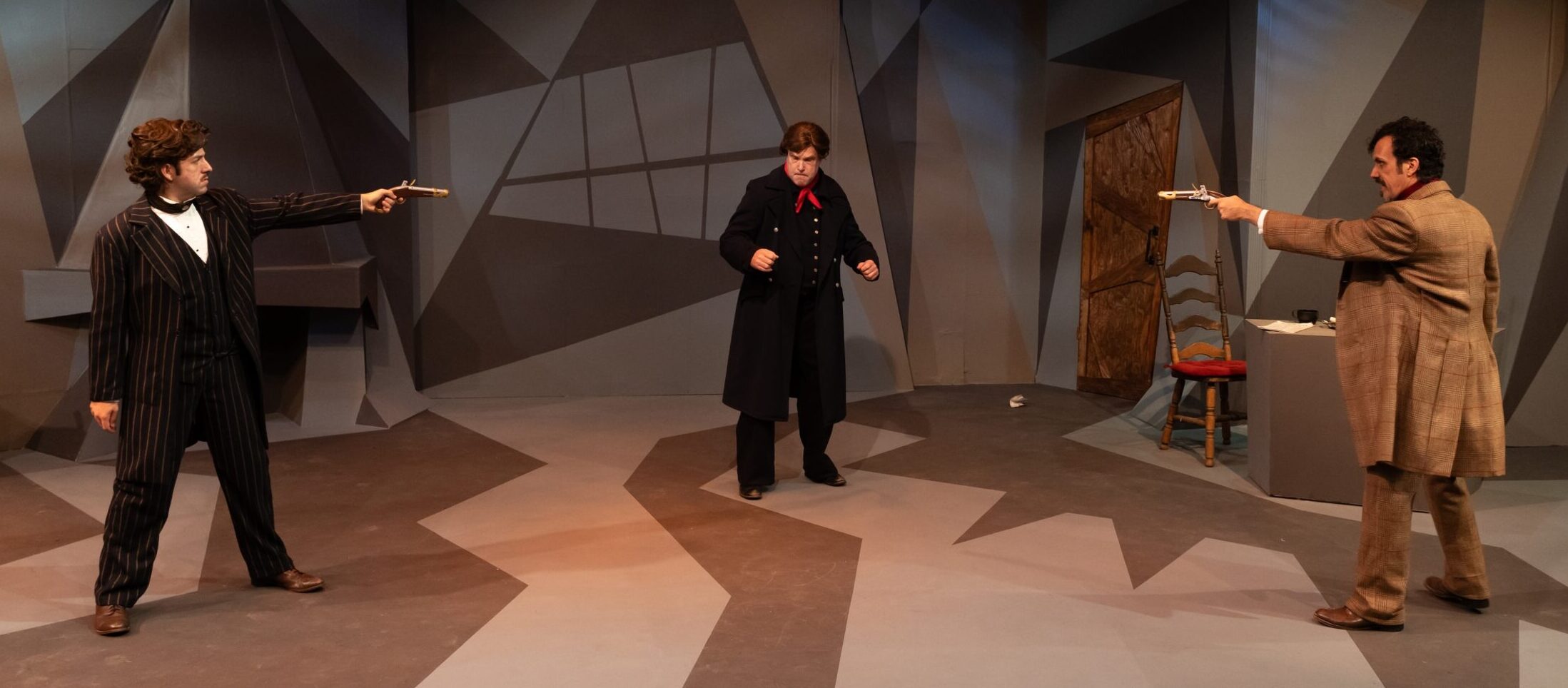
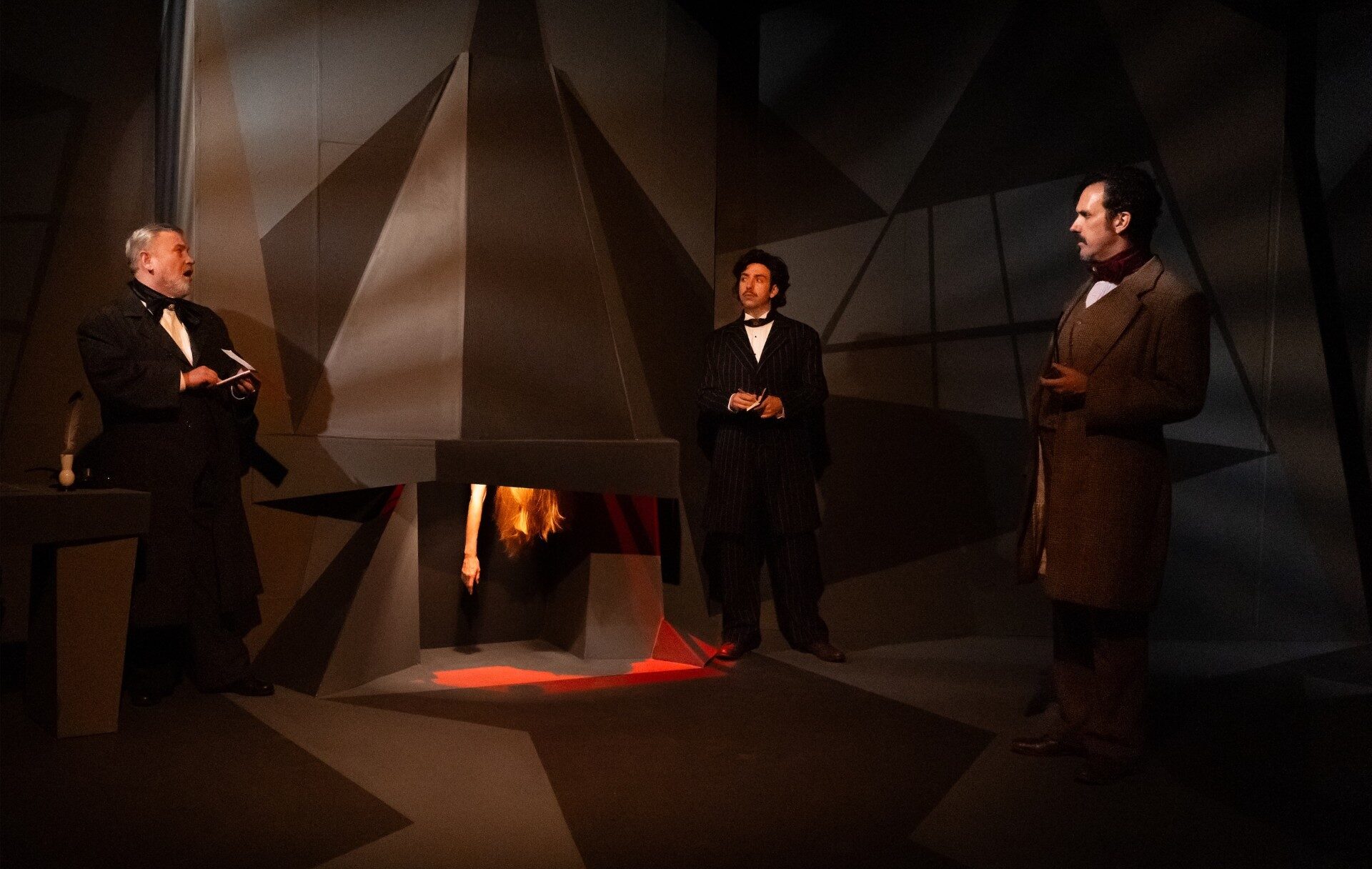
Patrick Grant, Randall Craig, and Michael Mullen. Photo by Eric Keitel.
So, to learn of the content of Poe’s “tales,” (as they’re classified,) was somewhat interesting. But that’s where the interest in this one stopped for me. I had no idea what was occurring—I kept waiting for something to happen instead of people just talking about what happened. (My first note when I saw The Case-Book of C. Auguste Dupin was actually, “A bit too talky for me.”)
Gigi, who is a high school English teacher and dedicated Poe aficionado, told me that she “loves the way Poe writes horror,” and that her students are big fans of his The Raven and The Tell-Tale Heart. But she was unfamiliar with these three stories, so she would have been interested in discovering them. But even she, one of my most intelligent friends, was confused about what was going on with them.
And the show is soooo slow. My gosh. It was like watching a 1-0 baseball game. For you non-sports fans, that means that it’s boring, (but the best to take a nap to! So, if you’re having trouble sleeping at home, this may be the destination for you!)
On top of all that, there’s a really weird ending. This is how that went when Gigi and I saw it: the show was over, the actors took their bow, we applauded and got up to leave, and then…they started talking to the audience, speaking as themselves! As Gigi explains, “They wanted us to know that the criminal and detective minds eventually become one.” No one cared at that point. (And even with my mega-memory, I had forgotten the purpose of that announcement by the time I got home! Gigi had to remind me.)
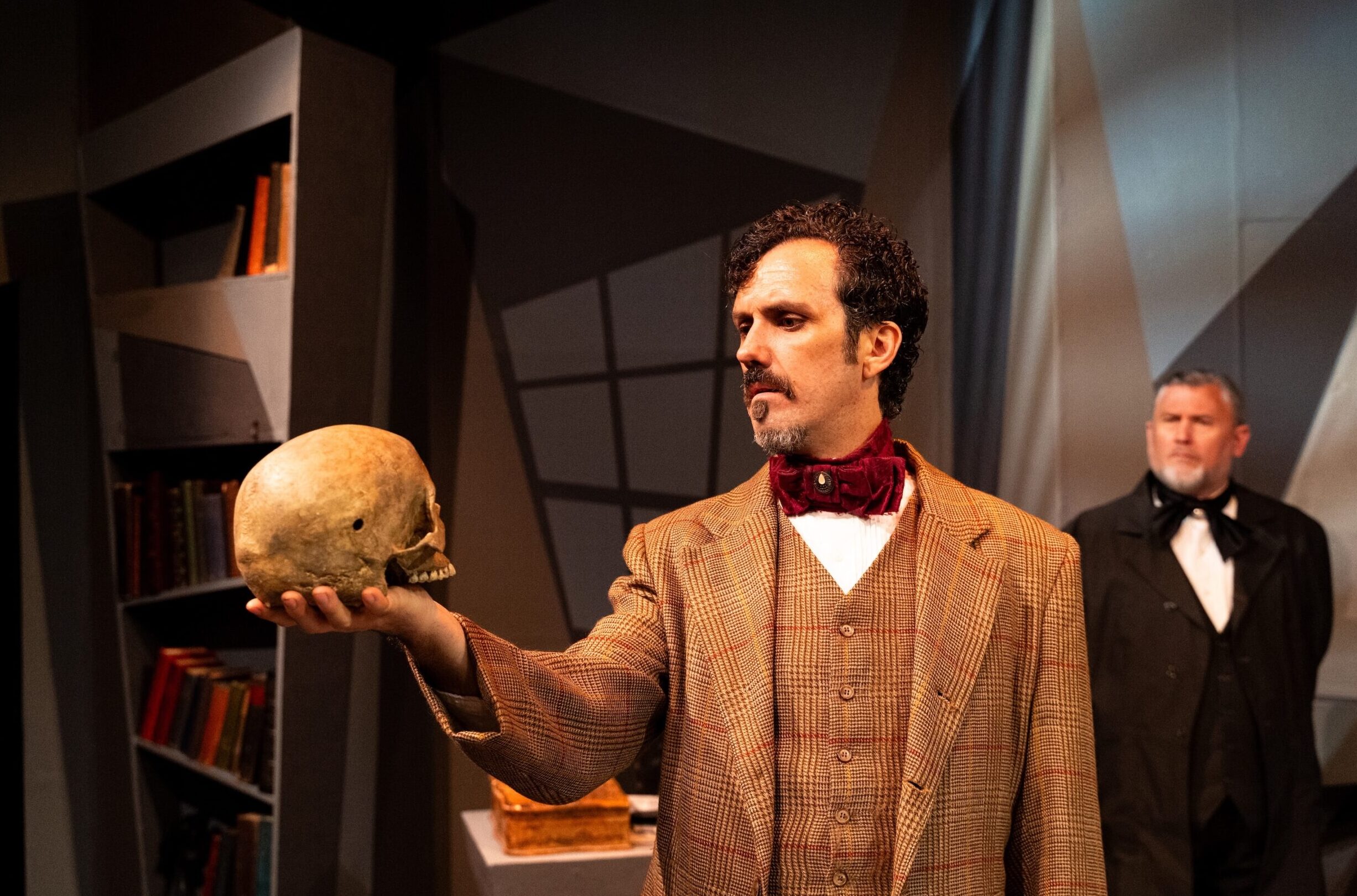
Michael Mullin and Todd Andrew Ball. Photo by Eric Keitel.
Speaking of the actors, I’ve seen Michael Mullins, who plays Dupin in this one, in several previous productions, and I must say that this is the best he’s ever been-–he’s very suited to that lead role. It is a bit perplexing that the members of the cast are all doing different accents, (we didn’t know what half of the accents are supposed to be,) but that was also done in many old movies, so we just went with it. The strange thing is that although all the stories take place in France, there was none of that one! But it is always a tad hard to discern words spoken in a French accent, so I was fine with that omission. I want to stress that the six actors are fine otherwise. So I blame the pacing and weirdness on the director, John Strysik, who also put these stories together and wrote the script.
However, there is some humor to The Case-Book of C. Auguste Dupin. I love the line, “That’s quite a pastry,” which I can’t wait to use on someone. I learned of some good hiding places, as well.
As much as this part of the review pains me, I have to be honest and say that this is the first time I have ever been even slightly disappointed in a Jeff G. Rack set. I had been singing the praises of his sets to Gigi on the way over, so I was a bit shocked when I saw this bare-ish one. I’m sure it’s supposed to be artistic, but it just doesn’t mean anything nor enhance the experience. (And the actors really need to put those silencers—such as moleskin or gaffer tape—on their shoe soles!)
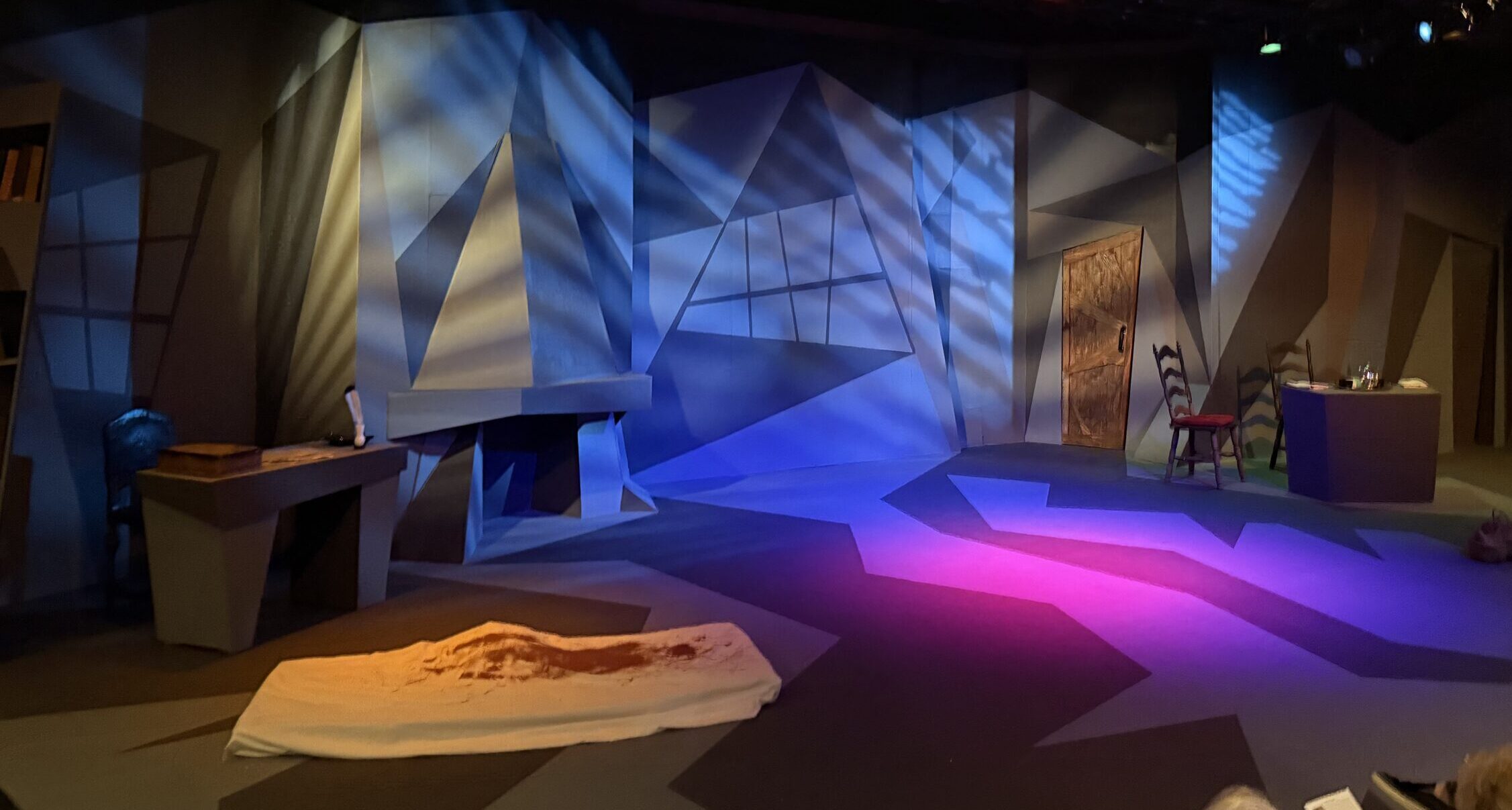
The set before the show. It looks much better with these colored lights than it does when the show is going! Photo by Karen Salkin.
Worse than anything, though, is the stage lighting—once again for recent Theatre 40 productions, it’s awful. It’s just waaaay too dark when they do period pieces. I keep reminding them that we’re there to see a play—not live in the era—so we want to be able to actually see it! I had been looking forward to seeing The Heiress there next, but I’m afraid that they’ll hire Derrick McDaniel again, and his lighting is always sooo dark that it’s actually painful. It not only makes my eyes hurt, but—I hate to admit it—I fight to keep them open! At least three of my pals have told me they go through the same thing with the lighting at these shows, but I was shocked to hear that it happened to Gigi, too, because…she’s really young! It’s not like she needs the siesta; it just happened, she says, due to the dark lighting.
Since I’ve just set low expectations, and you all now know how the narrative goes, you might like The Case-Book of C. Auguste Dupin more than we did. I was expecting a show that’s the caliber of most of Theatre 40’s usual productions, and done as a real play, with action, as opposed to what is basically a discussion; hence my disappointment. If you’re an Edgar Allen Poe fan, I think you’ll be happy to see a few of his tales told here, because since he wrote only one play, it’s a rarity to see any works of his dramatized.
The Case-Book of C. Auguste Dupin running through October 18, 2026
Theatre 40 241 S. Moreno Drive, Beverly Hills
310-364-0535 www.theatre40.org