WHAT OPA DID
Everyone in America needs to see this play right now, but only those in SoCal will have the privilege for the next four weekends. It’s the World Premiere of What Opa Did, in partnership with the Holocaust Museum LA.
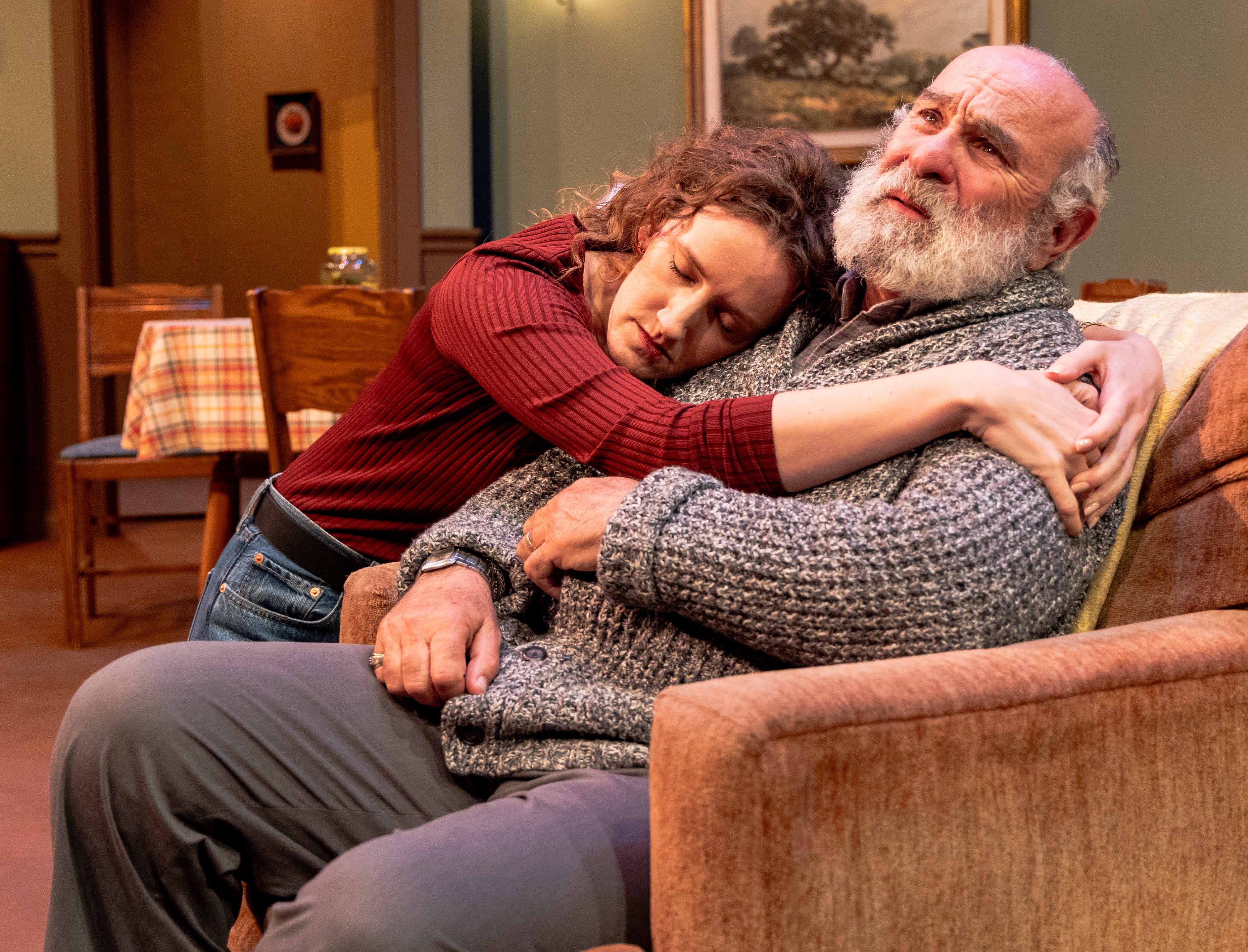
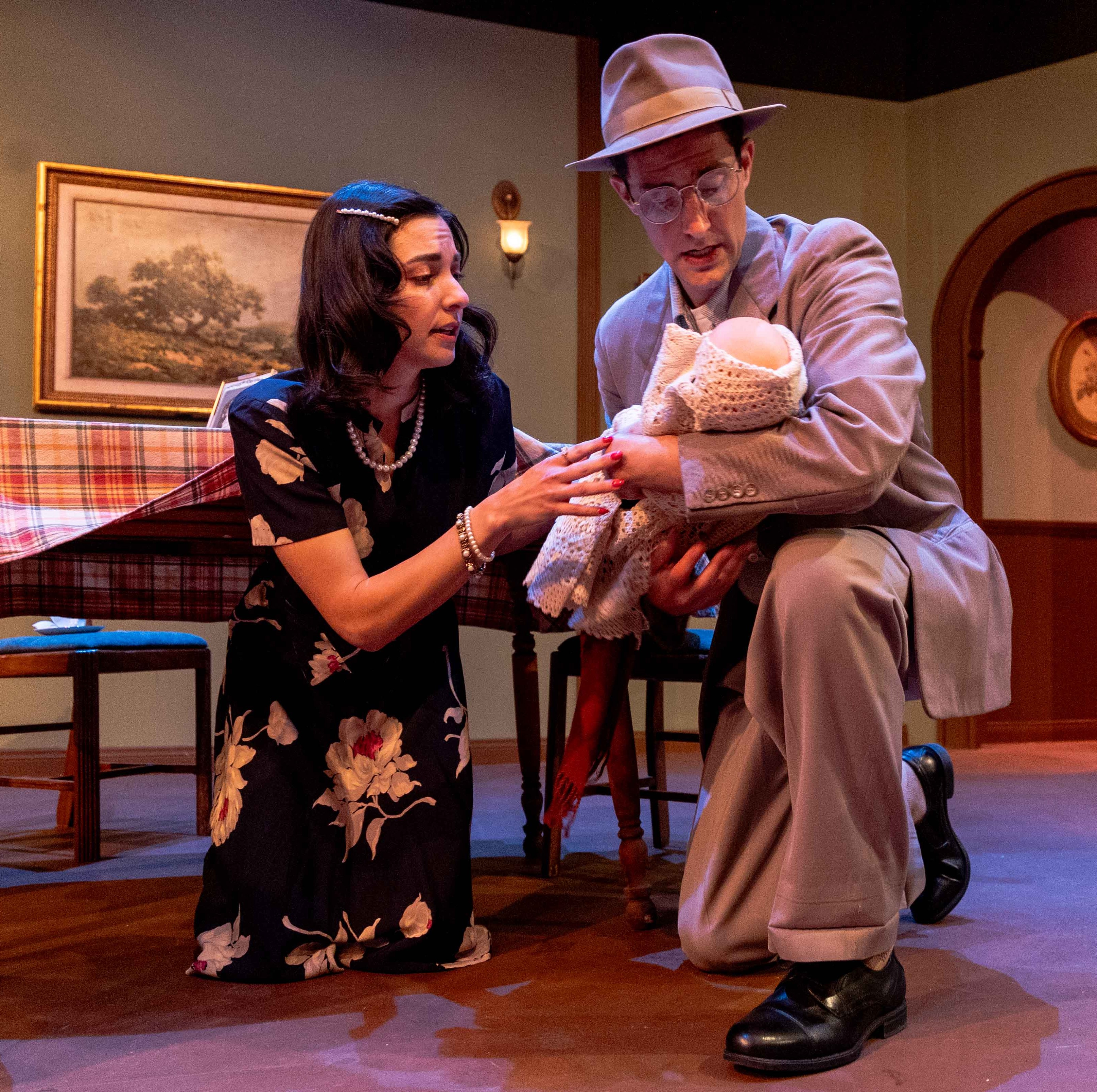
Meghan Lewis and Allan Wasserman. Photo by Demian Tejeda-Benitez.
In the more than a decade that I’ve been reviewing plays at Theatre 40 in Beverly Hills, this is the heaviest show I’ve ever seen them do. (For reference, their next two shows are an Agatha Christie mystery, which is one of their specialties, followed by a play version of a famous old movie rom-com.) But What Opa Did is perhaps also their most important, especially at this time in our history.
I wrote the following in my very first review at this theatre, eleven years ago, where the subject of that play, Blonde Poison, was also the Holocaust: “In all honesty, if I had known the topic of this dramatic […] play beforehand, […] I wouldn’t have gone.” And then explained that sentiment a bit further on, writing, “Being Jewish myself, […], I try to avoid all shows, films, plays, and stories about this horrible period of history. It’s just way too painful for me. But I feel that every now and then all of us need to be reminded of it, so having this play be staged right here in Beverly Hills is very important, not just to Jews, but to everyone.” Very sadly, all of that holds even more true today!
I’ve never understood how the Holocaust was allowed to happen in the first place, and why it took so long to stop the pure evil of Hitler. And devastatingly, with our country’s Orange Hitler, now I get it. There was nowhere safe for Jews to go in several European countries during World War II, and I can’t believe that it’s happening again in our own cities, for so many ethnic groups.
The basic plot of What Opa Did is that Kate, a middle-aged American woman, (Meghan Lewis,) is visiting her elderly Grandfather, (Allan Wasserman,) in his native Germany, (where “Opa” means” “Grandpa.”) What seems like just a normal, innocent familial get-together turns-out to be so much more than that. We learn of his younger, (Jeremy Schaye,) life with his wife and baby during the Holocaust. And the drama goes from there.
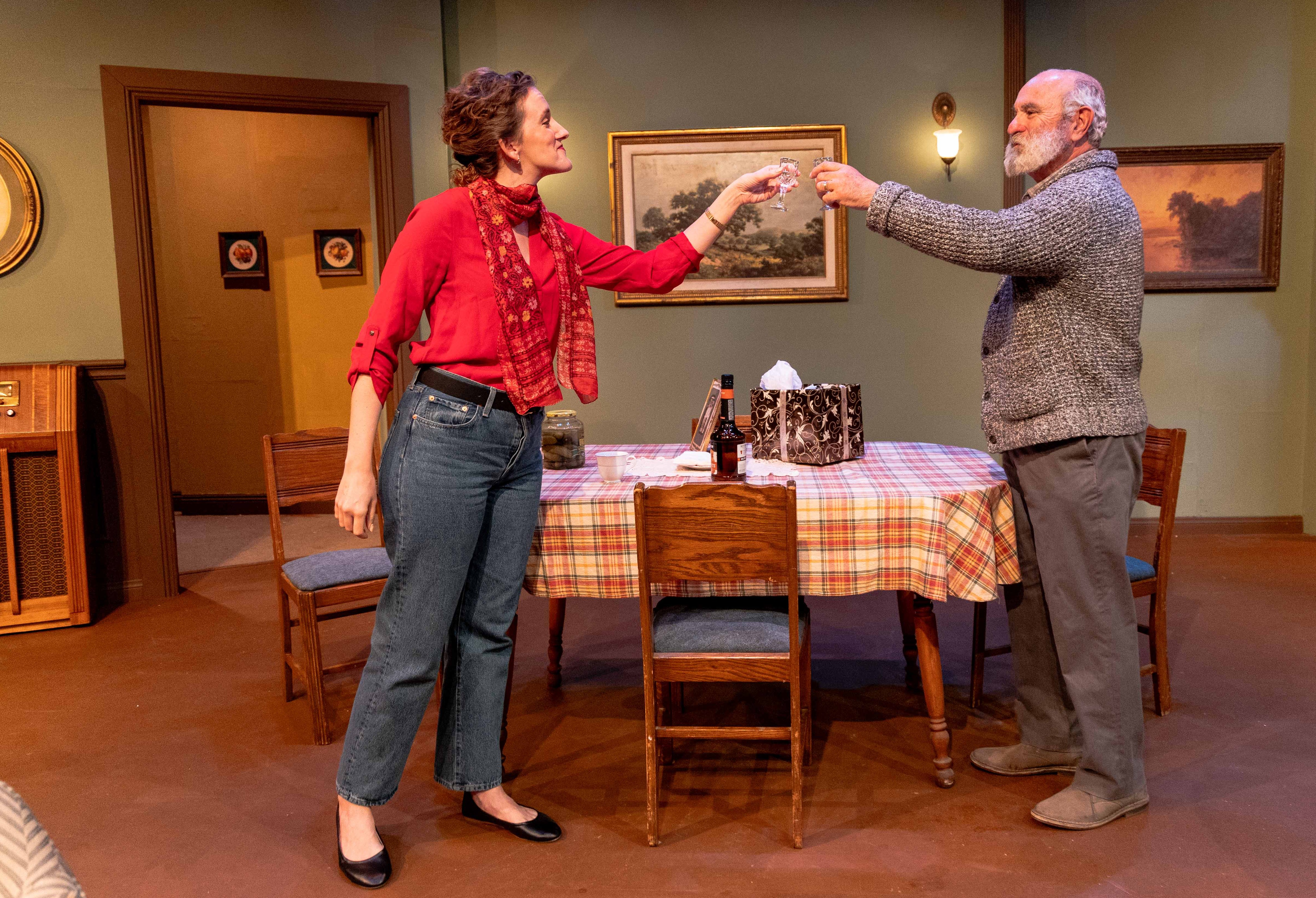
Meghan Lewis and Allan Wasserman. Photo by Demian Tejeda-Benitez.
The interesting tale is written by Christopher Franciosa and well-directed by James Paradise. It could have been a tricky proposition to go back and forth in time, especially on the same living room/dining room set, (designed by the prolific Jeff G. Rack, of course,) but the story is really pretty easy to follow. And they don’t even have to change the props from scene to scene! Well-done by all. (However, in all honesty, those not-changed-through-the-decades props can get a tad confusing. And the description of the scenes in the program is even more so! So do not read them. You can easily figure them out as they go along. Just know that the scenes between the woman and her grandfather take place in 1990. It’s written that way so that Opa is still alive after being a young man during World War II; that date also explains no cell phones, which we’re so used to in shows now.)
There are a few weaknesses in the script, but they really don’t matter much. An example is that the woman, who is mentioned as currently living in Brooklyn, is dealing with the Simon Wiesenthal Center, which is in LA. And this is in 1990! As someone who went back and forth between those two cities quite often at that time, (and always, actually,) I can tell you that, in those days of little technology and very expensive long distance phone call rates, that would be a strange occurrence.
The action is occasionally a tad slow, but it’s still riveting. I never once checked the time. Even at intermission!!! I highly recommend What Opa Did to everyone, old and young, Jewish and not, American, German, whatever.

Victor Montez and Lilli Passero. Photo by Demian Tejeda-Benitez.
The five actors are all excellent and very believable. My friend and I most admired the work of Lilli Passero, as the young half-Jewish wife. But it’s a tad disturbing to me that the young Nazi, played by Victor Montez, is so good-looking! I was torn between hating him and admiring his looks. But that’s most likely what the wife in the script goes through, as well, even though we both hate him more than anything.
The lovely classical music between scenes is appropriate, and a welcome touch.
Much of the script resonated with me in different ways, besides being filled with hatred against the Nazis. For example, Opa asks Kate, “What are you?,” to see if she answers, “Jewish,” or something else to describe herself upon meeting a stranger. That brought back fond memories for me of what two of my friends used to answer to that query. In our dance club days, my friend Michelle, who was 100% Jewish and the best dancer, was always hit on by guys of color, who then asked her what she was. (Which was rude to begin with.) They were really asking her if she’s black or white because, in all honesty, it was hard to tell with her. And she would very calmly and definitively answer, “American,” which shut their questions down. (But even I was never really sure!) And my young fake nephew, Ronnie, who is biracial, got that same question all the time…as a kid! And from complete strangers!!! Again, rude. But he was so beautiful and exotic that people really did want to know. But being smarter than everyone, he would always go into a whole big megillah about every ethnicity he had heard of in his big family, and even included me in it, by claiming that he was also “a little Jewish.” Which he definitely was not. But I totally loved it. All that is to say that the question from the Opa to his granddaughter really did ring true for me. (And, in case you’re curious, no one has ever asked me! Even my looks are an open book.)
Lilli Passero and Jeremy Schaye. Photo by Demian Tejeda-Benitez.
I’m Jewish, and smart, (if I do say so myself,) but What Opa Did showed me that I’m nescient about a lot of my tribe’s history, such as the creation of Israel, so I was glad to be apprised of some of it here. I didn’t even know that “Opa” means “Grandpa” in German! (My Jewish roots are more Russian, and I know lots of Yiddish words, but not German or Hebrew. As the play points out in a way, there are Jews and there are Jews.)
Now, here’s my one big issue with the production. I understand and appreciate what they are going for with all the dark lighting, but I absolutely hated it. I’m sure it’s designed to accommodate the depressing story, but this is a show—we want to be able to see it! And comfortably. My eyes were hurting the whole time. And in such an intimate theatre, I actually had to use binoculars, from just three rows back, to see the actors’ faces well enough. This venue is very popular with seniors, most likely because of the quality productions and overwhelming ease of experience, and I’m sure that they would like the stage to have a bit more light, as well. I actually heard a few audience members grumble about the darkness on stage at intermission. Just sayin’.
By the way, if playwright Christopher Franciosa’s last name seems familiar to you, yes, he is the son of ’50s -’70s handsome man movie and TV star, Tony Franciosa. So I was left scratching my head over why an Italian guy like that would write a script like this one. It turns-out that his mother is Jewish, and she and her family lived through the Holocaust! Who knew? (On a side note—Italian men and Jewish girls make the best couples. Of course they do, because that’s what Mr. X and I are!)
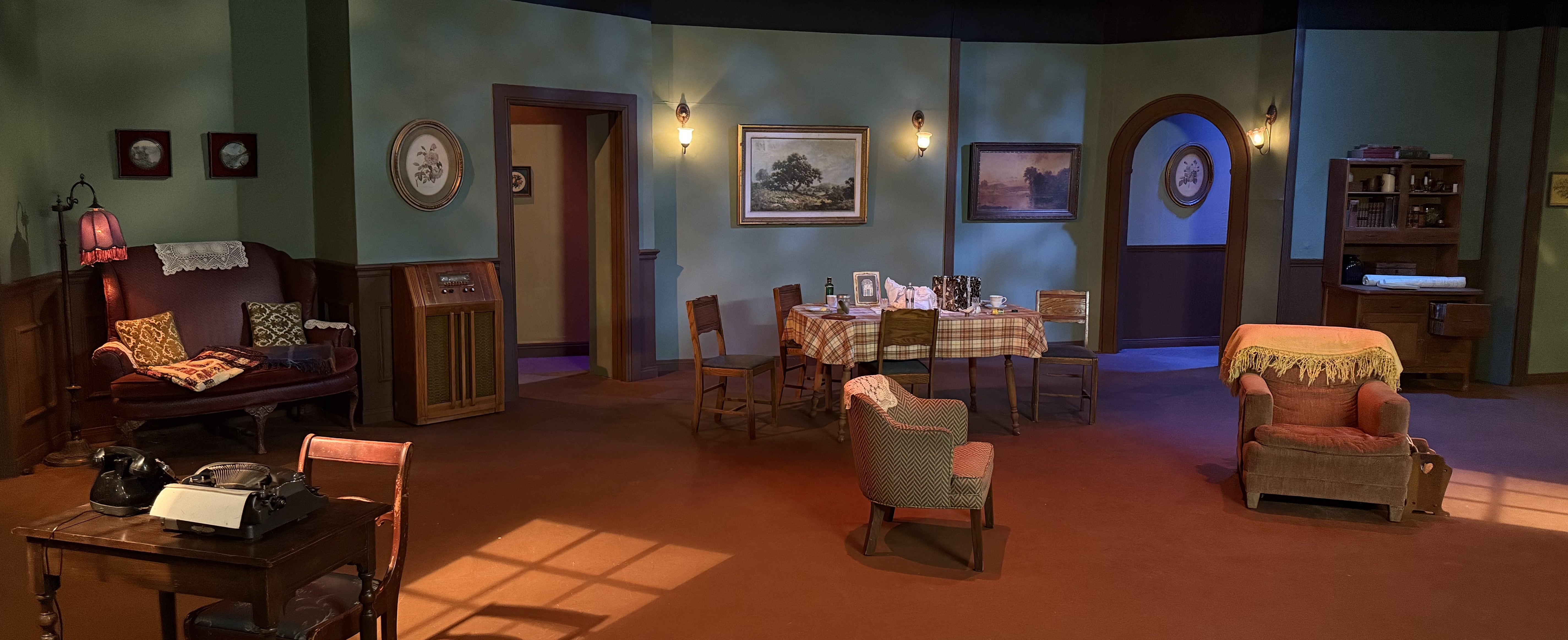
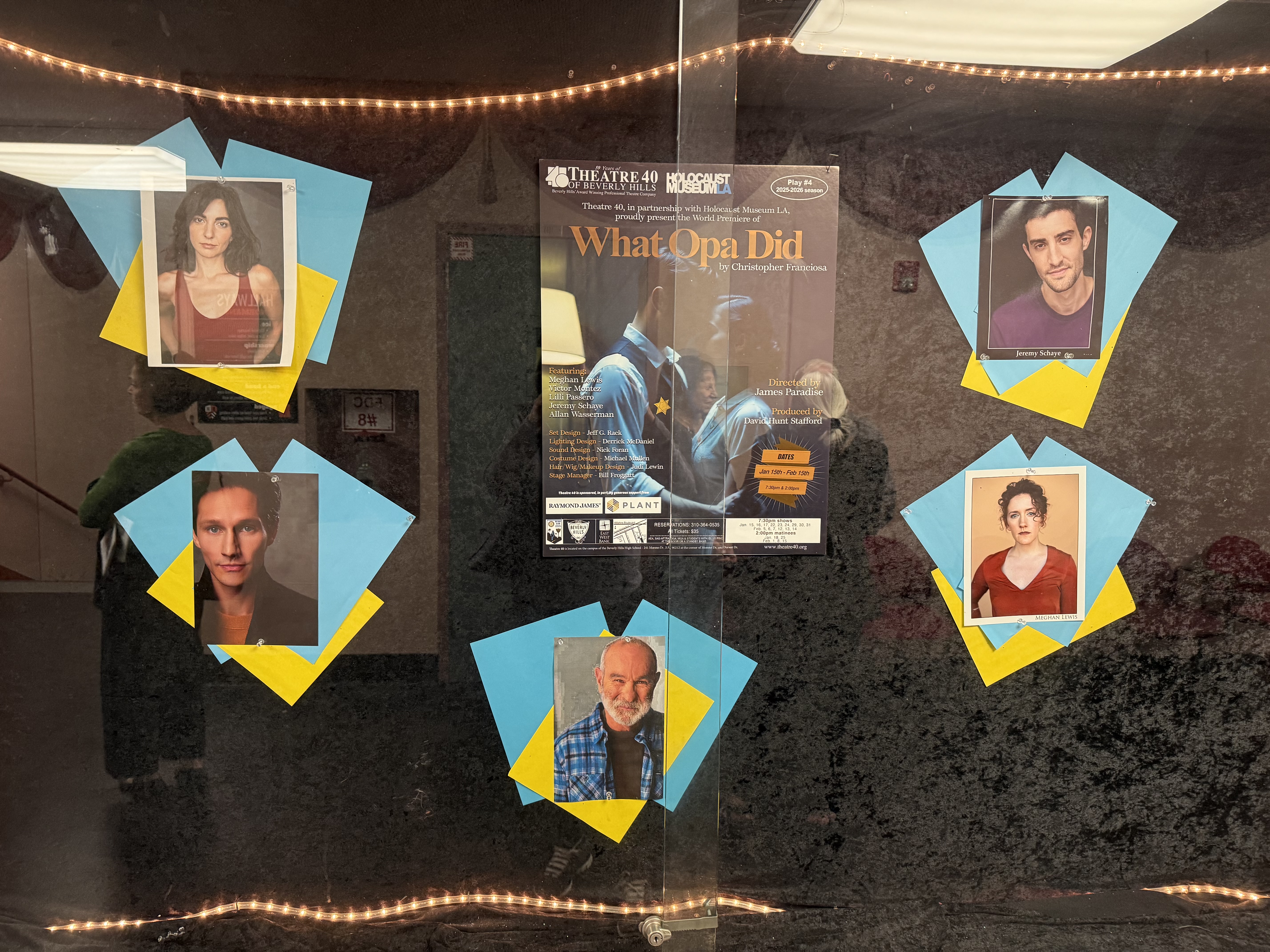
The What Opa Did set. Photo by Karen Salkin, as is the one of the lobby display at the top of this review.
What Opa Did reminded me that I’m always still a little scared of Germany, even after all these decades. Way back in the ‘90s, when the world was actually far less scary than it is now, a friend of mine told me that he always goes to Germany to buy his BMWs. He said they fly their customers out there, put them up, charge about half the price of what they would pay here, and then ship the car back to LA for them. I thought that was a wonderful concept, and I told the non-Jewish Mr. X that I wanted to do the same thing. He was aghast at that idea, and told me that I should never go to Germany because I’m Jewish. And I realized that he was correct—I’d probably be very upset and on edge there the whole time.
As I definitely was while watching this play. But in this instance, I was feeling all those emotions in a good way. I was enjoying the excellence of the production, and the narrative made me more determined than ever to help America get back to better times.
Go see it!!!
What Opa Did running through February 15, 2026
Theatre 40 241 S. Moreno Drive, Beverly Hills
3
10-364-0535 www.theatre40.org